- Jun 13, 2024
How to Learn Kanji the Fun Way (an Adult-Friendly Approach That Makes Characters Stick Forever!)
Learning to read Japanese unlocks one of the world's most fascinating cultures, its world renowned literary tradition, and all the manga you could ever want! Moreover, it creates richer travel and culinary experiences, boosts career opportunities, and connects you with over 120 million+ possible Japanese penpals!
But you can't just jump in and start sounding words out the way an English speaker can with Spanish. Unlike English's simple 26 letters (or Spanish's 27), Japanese has 92 "kana" (46 hiragana and 46 katakana) and 2,136 "common-use kanji" (常用漢字).
And you need to be able to read and pronounce all three of these scripts to be considered "literate" in Japanese.
Yikes!
If you haven't learn kana yet, I teach you exactly how in my post Crack the Kana Code: The Best Way to Learn Japanese Hiragana & Katakana, which includes a recommended 12-day study plan.
But that still leaves kanji...
Unfortunately, conquering 2,000+ complex characters will take much more than 12 days...
But! If you use the method detailed in this article, I promise that it won't take you 12 years as is does for most Japanese children.
Are Kanji Difficult?
A lot of people believe that learning kanji is the most difficult part of Japanese.
And not just foreigners! Most native speakers of Japanese believe this, too!
The truth?
Kanji are indeed difficult if you learn them using the same method used by Japanese children.
Namely, relying on rote memory and written repetition.
You've likely tried this approach yourself, so you already know how boring, time-consuming, and ineffective it can be.
First, you stare intensely at a character, trying desperately to sear the strokes into your memory.
Then you write out the character a few dozens times, attempting to imitate the model as closely as possible.
You hope that the reps and muscle memory will make the kanji stick.
When you quiz yourself by writing the kanji from memory 20 minutes later, you quickly get demoralized.
"Ugh, the damn thing has completely evaporated. I can't even remember the first stroke!"
You flip the paper back over and look at the character again.
"Oh yeah! That is what it looks like."
You write out the character 20 more times, filling up all the remaining practice boxes on your worksheet, fingers crossed that you this time will be different. Hoping that maybe you just didn't "rote hard enough."
You then move on to the next ten characters in the list, following the same brute-force method.
But when you hide the models and attempt to write the list on a blank page 20 minutes later, once again, you're grasping at straws. Or rather, strokes!
You manage to get a few squiggles down on the page, but you mix up two of the kanji, forget an important chunk in another, and completely blank on the rest.
You think to yourself:
"My memory really sucks! Maybe I should just give up learning Japanese."
But no, I assure you that your memory doesn't suck.
Your method does.
Our brains did not evolve to encode random facts or collections of strokes through sheer repetition.
Creating new memories takes a lot of valuable nutrients, and your body has to prioritize what is worth encoding and what is ignored.
In general, priority is given to information which meets one of two criteria:
It aids in our survival.
It improves mating opportunities.
And how does the brain filter for such pivotal knowledge?
Emotion.
Think about it: You have no trouble remembering things that amuse, excite, fascinate, shock, or terrify you.
You don't even have to try to remember such things. They just stick automatically.
I bet you remember the exact moment you met your significant other in sharp detail.
Or that time that you barely skirted death.
And I'd wager good money that you recall exactly where you were when the planes struck the World Trade Center on September 11, 2001.
🎳 Side Note: I was at a bowling alley in Nagoya, Japan while visiting some Japanese friends there during university, and got stuck for an extra week because all the flights back to the states were cancelled!
Heck, I bet you can even rattle off countless quotes from Star Wars or Austin Powers, even though this likely has no impact on your survival or sex life. But the films are amusing (at least to some of us 😉), which make the memories stick like Velcro.
So no, your memory is not the problem.
The issue here is lack of emotional connection to the kanji.
A Better Way
Fortunately, there is a much more effective way to get Chinese characters into your head and never forget them!
An adult-friendly approach that:
Leverages your unique life experiences.
Builds stronger, emotion-rich connections.
Aligns with how the human brain encodes and recalls memories.
So what is this magical method you ask?
Story-based mnemonics.
Instead of trying to force-feed random strokes into your long-term memory, you will instead leverage the power of vivid mental stories to quickly and efficiently memorize all 2,136 common-use characters.
These simple narratives:
Only take moments to create, but allow you to accurately recall the characters for the rest of your life!
Make learning much easier than the tedious rote method employed in Japanese schools.
Make learning kanji fun! (It's okay if you don't believe me on this just yet.)
But before I dive more into learning kanji through mnemonics, let's quickly make sure we're on the same page about what exactly kanji are.
What Are Kanji? How Are They Used in Japanese?
The word "kanji" literally means "Chinese characters" (漢字), or more literally, "Han characters." This is because the characters were borrowed from China, primarily from the 5th to 9th centuries.
At that time, Japan lacked a writing system of its own, and began using the borrowed characters to (awkwardly) write Japanese.
But given the stark differences between the two languages, Japan began augmenting the characters to better express Japanese phonetics and grammar.
This process eventually led to the creation of Japanese kana, which are now used alongside Chinese characters to write Japanese.
For example, the following sentence uses all three scripts, with:
katakana in yellow
hiragana in blue
kanji in black
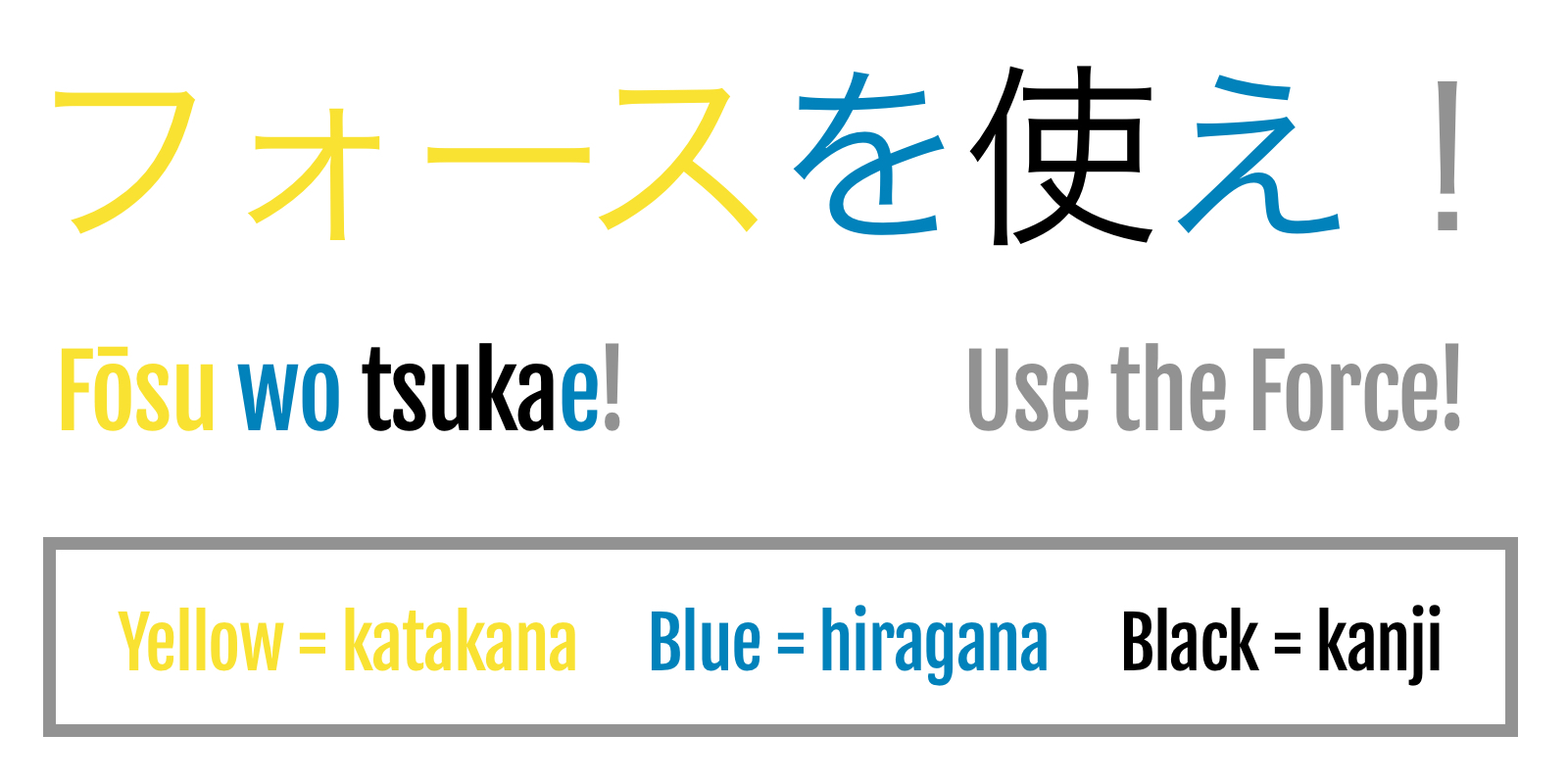
The word fōsu (フォース, "Force") is written in katakana (as most foreign loan words are).
The object marker wo (を) is written in hiragana (as all grammatical particles are).
The stem of the verb tsukaeru (使える), here in its command for tsukae (使え), is written in kanji.
The grammatical ending of the verb, -e (え) is written in hiragana.
Are Kanji Considered "Pictographs"?
Contrary to popular belief, most kanji are not pictographs or pictograms.
The vast majority are, in fact, "phono-semantic compounds" that combine two basic chunks:
One component indicates how the character is pronounced.
One component points to the character's meaning.
More on this in a moment.
Technically speaking, there are actually six classifications of kanji:
Pictographs
Simple Ideographs
Compound Ideographs
Phono-Semantic Compounds
Derivative Characters
Loan Characters
Let's quickly look at each, and the percentage of the common-use characters they represent.
① Pictographs
"Pictographic kanji" (象形文字) visually depict real-world objects through stylized drawings. They represent about 4% of Jouyou Kanji.
Here are some common examples:
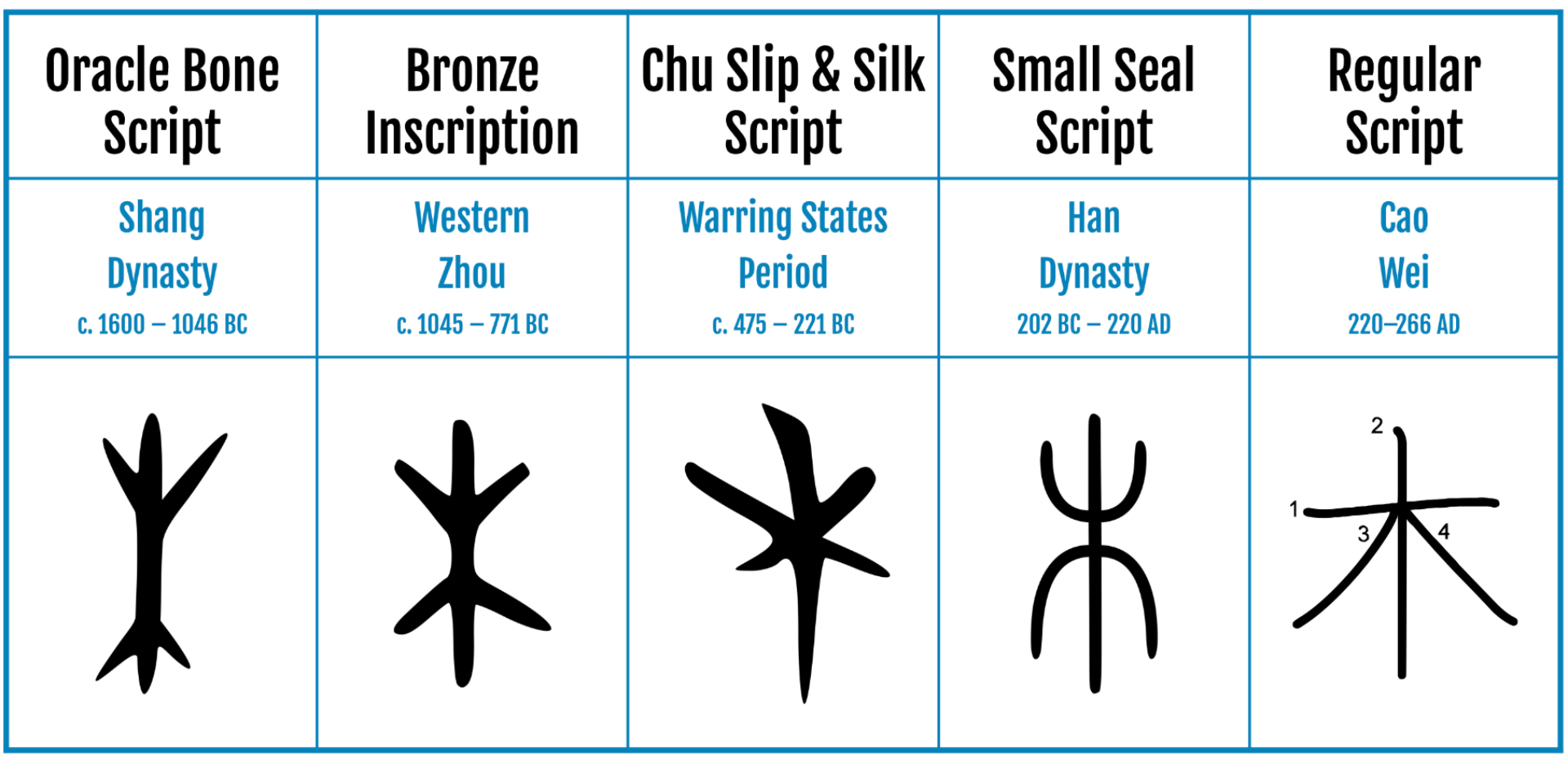
The pictograph for "tree" looks like this: 木
The pictograph for "mountain" looks like this: 山
The pictograph for "river" looks like this: 川
As you can see, it's not immediately obvious what objects these kanji refer to. This is due to centuries of graphical simplification and orthographical shortcuts.
A quick look at the original forms used in the Shang Dynasty (c. 1600 – 1046 BC) make the association much more clear:
② Simple Ideographs
Around 2% of the Jouyou Kanji are are comprised of "simple ideographs" (指事文字), which represent abstract concepts through symbolism and visual association. For example:
The ideograph 上 indicates the meaning of "up" with an object placed above a line.
The ideograph 下 indicates the meaning of "down" with an object placed below a line.
The ideograph 中 indicates the meaning of "middle" with a vertical stroke placed in the center of an object.
The line between "pictograph" and "ideograph" can be fuzzy, but the former tend to be more concrete and explicit, and the latter more abstract and implicit.
③ Compound Ideographs
"Compound ideographs" (会意文字)—which represent about 13% of Jouyou Kanji—combine two or more pictographs or ideographs into a new character.
For example:
The character 休 (meaning "rest") combines 木 ("tree"), which you just saw above, with the character 人 (meaning "person"). Together, you have "a person resting against a tree."
The character 明 (meaning "bright/brightness") combines 日 (sun) and 月 (moon) together, both of which shine brightly in the daytime or nighttime sky, respectively.
The character 炎 (meaning "inflammation" or "blaze") combines two 火 (fire) radicals, symbolizing not a mere fire, but a conflagration.
④ Phono-Semantic Compounds
"Phono-semantic compounds" (形声文字) are kanji that include two main parts:
A "phonetic indicator" that (roughly) indicates the character's pronunciation.
A "semantic indicator" that (roughly) indicates the character's meaning.
This is by far the most common type of kanji, making up approximately 80% of the Jouyou Kanji!
Here are three examples, which all happen to share the same component 工:
The character 紅 (“crimson”) combines the semantic indicator 糸 ("thread") with the phonetic indicator 工.
The character 虹 (“rainbow”) combines the semantic indicator 虫 ("insect") with the phonetic indicator 工.
The character 江 (“creek”) combines the semantic indicator 水 · 氵 ("water") with the phonetic indicator 工.
Thanks to the influence of the shared phonetic indicator 工, all three of these characters are pronounced the same way: kou (コウ). At least when using their readings of Chinese origin called on-yomi (音読み). Their readings of Japanese origin—called kun-yomi (訓読み)—are unrelated.
But bear in mind that sharing a phonetic indicator is no guarantee that kanji will have identical pronunciations. And that many characters have multiple on-yomi and kun-yomi. Kanji pronunciation is a tricky business, and is arguably more difficult than learning the meaning and writing of the characters themselves. More on this later.
⑤ Derivative Characters
"Derivative characters" (転注文字) are kanji that have taken on significantly distinct meanings from their original sense. Such characters are less common (less than 1% of the Jouyou Kanji), and represent a fairly fuzzy category that some linguists dispute.
A common example is the character 楽, which originally meant "music," as used in the compound on-gaku (音楽, "music"). But its meaning eventually extended to "comfort" or "ease," such as in the word Raku-en (楽園, "Eden"; lit. "comfortable garden").
⑥ Loan Characters
Lastly, there are "loan characters" (仮借文字), which are kanji used for their phonetic value rather than their meanings.
Historically, such characters were used to write foreign countries, names, and concepts. But in modern Japanese, this task is usually accomplished with katakana instead.
For example, "America" is now written in katakana as アメリカ (a-me-ri-ka), but it can also be rendered in kanji as 亜米利加.
How to Learn Kanji Using Story-Based Mnemonics
Okay, enough background on kanji. Let's now get into the nitty-gritty details of exactly how to learn kanji through stories.
Step 1: Learn the most common "Lego pieces" that make up kanji
Most kanji are made up of two or more smaller chunks.
For example:
The kanji for "woods" or "grove" (林) is simply the kanji for "tree" (木) repeated two times, while the kanji for "forest" (森) triples up the tree component.
The kanji for "timber" (材, pronounced zai) is a phono-semantic compound combining the semantic indicator 木 ("tree") with the phonetic indicator 才 (pronounced sai).
It's critical to learn these chunks for two key reasons:
A relatively small number of them make up the vast majority of kanji. These high-frequency "Lego pieces" make up nearly all 2,136 Jouyou Kanji. So you don't actually need to learn 2,000+ completely unique characters. Rather, you need to learn ≈2,000 novel combinations of roughly 200 basic building blocks.
You will use these components as "characters" in your story mnemonics. 200+ actors may be a lengthy cast list for your mental kanji movies, but you will soon get to know all of them just as well as you know the myriad characters in The Lord of the Rings, the Marvel Cinematic Universe, etc.
So what are these chunks? And how many are there?
Well, it depends who you ask!
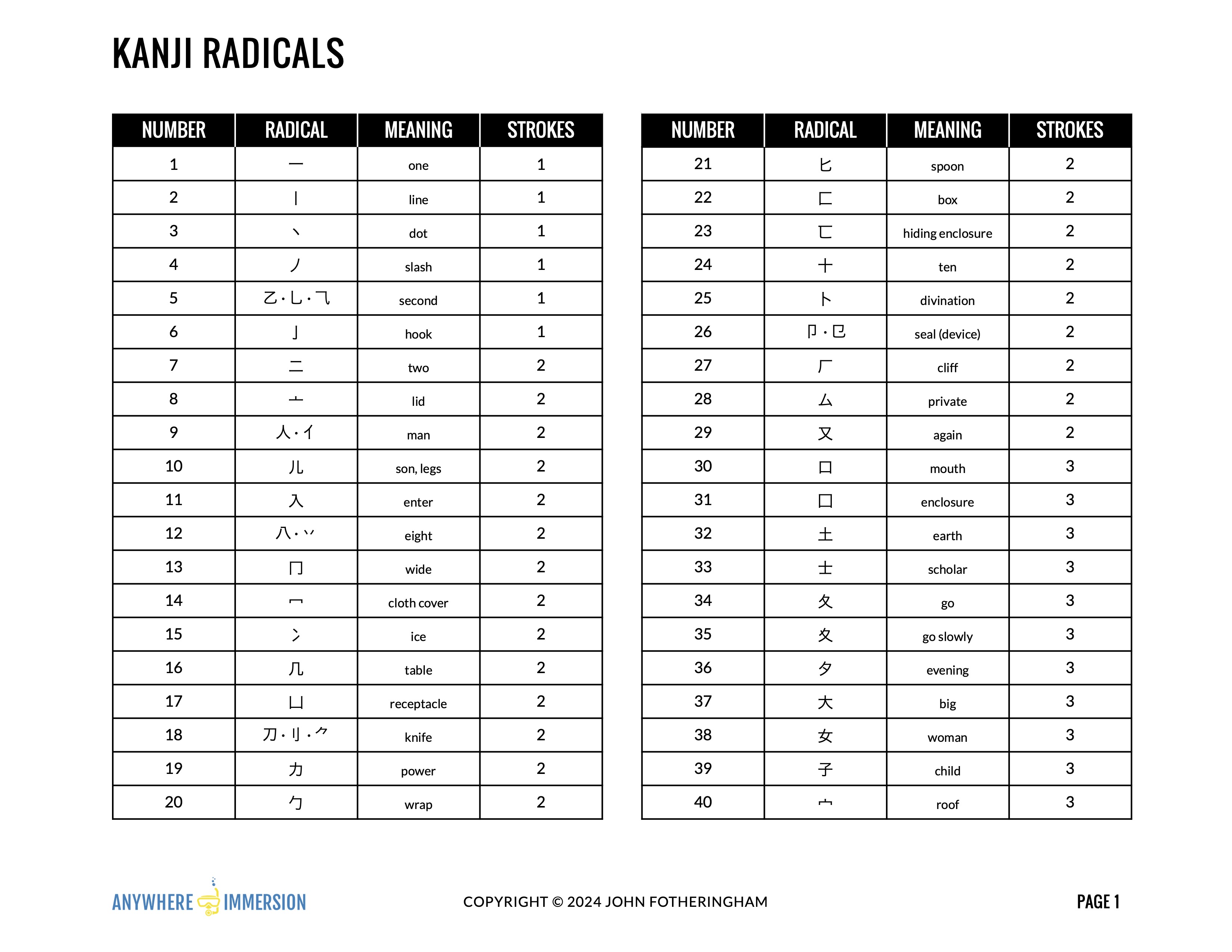
Traditional Chinese and Japanese dictionaries list 214 official "radicals" (部首, lit. "section headers"), pronounced bù-shǒu in Mandarin and bu-shu (ぶしゅ) in Japanese. This convention was established in the 1716 Kangxi Dictionary (Kāng-xī Zì-diǎn, 康熙字典), created by order of the Kangxi Emperor (Kāng-xī Dì, 康熙帝).
You can see the complete list of kangxi radicals on Wikipedia here, or you can download my free print-ready kanji radical cheat sheet here. Here's a sample page from the PDF.
While these 214 official "radicals" are useful to know, I actually a recommend using the somewhat expanded set of 228 "primitive elements" used in Remembering the Kanji (RTK) by James Heisig.
While many of Heisig's "primitives" match up exactly with the Kangxi radicals, he does occasionally depart from the official list when it helps learners.
For example:
Adding certain frequently repeated chunks that are not official Kangxi radicals.
Departing from original meanings to help you keep similar components distinct.
If you go with Heisig's method, you don't need to learn the entire list of primitive elements in one go. Rather, you will learn them sequentially and systematically as they are needed to continue creating new kanji. As Heisig argues in the introduction to Remembering the Kanji:
"If these primitives are presented in orderly fashion, the taxonomy of the most complex characters is greatly simplified and no attempt need be made to memorize the primitive alphabet apart from actually using it."
Which bring us to the fun part: using the radicals or primitive elements to create story-based mnemonics!
Step 2: Create distinct, memorable stories for each character
Rote memorization is ineffective for learning kanji because it relies on visual memory and muscle memory. Both of these help a little, but it turns out that there is a much more powerful form of memory that is perfectly suited to learning complex characters: "imaginative memory."
Heisig defines the term as follows:
"...the faculty to recall images created purely in the mind, with no actual or remembered visual stimuli behind them."
In essence, your job is to weave the chunks/ radicals / primitive elements into unique, whacky, unforgettable mental stories or scenes.
Instead of trying to remember a random pile of strokes (really hard), you simply have to recall a story (easy). The story then triggers the character's form.
For example, here's a story mnemonic you could use to remember the kanji for "rainbow" (虹) that I mentioned above.
First, let's break it up again into its constituent primitive elements:
insect (虫)
craft (工)
Your job now is to build a little narrative or scene in your head that combines "insect," "craft," and "rainbow."
Perhaps something like this:
A giant swarm of artistic insects (虫) combined forces to craft (工) a gorgeous rainbow (虹) in the sky.
But this is just one possible story. You can create whatever associations make the most sense to you.
Maybe you prefer something with a bit more drama, like this one from a user on the great Kanji Koohii site:
For my arts and CRAFTs project at school, I made a rainbow out of dead BUGs spray painted different colors and glued to some paper. The teacher was not amused.
Sometimes, the associations will be immediate and obvious. Other times, it will take a bit more work to create a vivid, memorable story. But the more you practice creating story-based mnemonics, the better (and faster!) you will get.
And you aren't left completely on your own to create every single story from scratch.
In Part One of Remembering the Kanji, Heisig provides a fully fleshed out story for each character to train you up on how to create effective mnemonics.
Then in Part Two, you are presented with the broad strokes of a story but given the freedom to fill in the details yourself.
And by the time you make it to Part Three, your imaginative memory muscles will be nice and strong, and it will be time to completely remove the training wheels. Here, you are shown only the character meaning (what Heisig calls the "key word"), and its constituent primitive elements.
Here are some tips to get the most out of Remembering the Kanji and create effective story mnemonics:
Get weird & wild
When you find yourself struggling to recall a specific character, chances are that you didn’t spend enough time or creativity crafting a sufficiently wacky tale in your head.
The more zany, emotional, and unusual your imaginative memory stories, the easier you will remember the characters they point to.
Or, your stories are perhaps too rational. Always aim for emotional instead.
As Heisig puts it:
“The aim is to shock the mind’s eye, to disgust it, to enchant it, to tease it, or to entertain it in any way possible so as to brand it with an image intimately associated with the key word. That image, in turn, inasmuch as it is composed of primitive meanings, will dictate precisely how the characters is to be penned―stroke for stroke, jot for jot.”
So let your imagination run wild and don't censor your thoughts.
Crudity is fine. Salaciousness is welcome! Nobody else ever needs to know what plots or associations you use.
Don’t rush & invest the necessary time to create rich stories
Creating effective “imaginative memory” stories can take a little extra time up front, but it’s well worth the investment in the long run.
Would you rather spend a single 5-minute session now to fuse a character into long-term memory, or have to come back to the character again and again hundreds of times because you didn’t spend enough time to make an effective story?
Confirm the exact meaning of each "key word"
The foundation of the RTK system is the single English key word he has connected with each character. To ensure that you don’t waste time and energy creating a story that conjures up the wrong concepts, make sure to look up any unknown key words using one or more of the following tools:
Step 3: Quiz yourself
If you create a sticky enough mental mnemonic, you should be able to recall the story (and the kanji form it points to) with ease. But you won't know how good your stories are until you try to write a character from memory a few hours, days, weeks, or months after you first encounter it.
You need an efficient way to spot holes in your knowledge, identify which characters have shaky story-mnemonics, and which kanji deserve a bit more attention.
This is where flash cards come in. You can go old-school and create physical versions using thick card stock (Heisig gives instructions for this in Lesson 5 of Remembering the Kanji 1) or you can use one of the many "spaced repetition" apps that automatically schedule reviews. Or both!
Use a spaced repetition system (SRS)
Spaced repetition systems (SRS) optimize memory retention by scheduling reviews of information at gradually increasing intervals (a method is based on the "spacing effect"). SRS tools use algorithms and self-reported scoring to predict the optimal review times for each piece of information, helping to combat the "forgetting curve" and enhance long-term memory retention.
Here are some of the best spaced repetition tools (all but the first are kanji-specific):
Anki: This is my go-to spaced repetition flashcard app. It's available on all the major platforms (iOS, macOS, Android, Windows, Linux, and web), allows extensive customization and personalization, and lets you either create your own flashcards or download premade decks from the Anki community (like this RTK deck).
Kanji Kohii: This free website works hand in glove with the RTK book and allows you to either add your own custom mnemonics or browse stories created by the community. In addition to their built-in spaced repetition, I also love that Kohii's smart dictionary only shows words that include kanji you've already studied.
Skritter: This great app (available on iOS, Android, and the web) builds stronger memories through "active production." Instead of simply looking at a character and quizzing yourself on whether you know it or not (passive recognition), the app has you write the character on the screen! And they have premade decks for RKT!
Wanikani: Tofugu's popular kanji learning site uses story-based mnemonics like RTK, but also introduces 6,000 high-frequency vocabulary words in context and teaches kanji pronunciations from the start (more on the pros and cons of this below). Fun Fact: "Wanikani" (鰐蟹) means “Crocodile Crab,” hence their logo!
⚠️ Note: The first three tools here should be used in tandem with Remembering the Kanji, not as replacements for the book. Use RTK to learn the characters systematically, and these SRS tools to review them efficiently.
Test yourself from English key word to Japanese character
Though there is certainly nothing wrong with testing your passive recognition of characters (as you will when reading authentic Japanese content), you will progress most quickly if you rely on active production. To that end, focus on quizzing yourself from from English key word to written character.
Write out each character by hand
Though RTK doesn’t require endless rote repetition to fix characters in your head, it is still a good idea to practice writing each character once or twice to play with the structure and get a feel for the strokes. You can either use pen and paper or write on your screen or track pad in the Skritter app.
Step 4: Learn kanji pronunciations (eventually)
One of the most common criticisms of the RTK approach is that you only learn the meaning and writing of the characters, but not their pronunciations (at least in the first book).
This is not a careless omission but an intentional choice to help you learn more efficiently. As Heisig argues:
"... it is hard to imagine a less efficient way of learning the reading and writing of the kanji than to study them simultaneously. And yet this is the method that all Japanese textbooks and courses follow."
Trying to learn the meaning, writing, and pronunciation together is A LOT to learn at once, so Heisig separates these tasks into two books:
Once you've built a strong foundation of the meanings and forms in Book 1 (which is actually the more logical part of kanji), you can then move on to learning the myriad pronunciations that go with each character in Book 2 (a far less intuitive undertaking).
This is actually the exact situation encountered by Chinese or Taiwanese people who learn Japanese. Since they already know the meaning of Chinese characters, they only need to learn how to pronounce them.
Yes, there are some visual differences between the kanji used in Japan, the simplified Chinese characters used in Mainland China, and the traditional characters used in Hong Kong and Taiwan, but there is enough visual continuity to infer a huge advantage.
This may largely explain why the vast majority of people who pass the N1 and N2 levels of the JLPT (Japanese Language Proficiency Test) are native speakers of Mandarin!
All that said, I know that some people simply prefer to learn kanji pronunciations along the way. If you fall into this category, I recommend that you use Wanikani instead of RTK.
Step 5: Get extensive exposure to authentic Japanese
These first four steps—albeit essential—are but the warm up you need to prepare for your primary practice: reading real Japanese.
Once you've learned the meaning of all the individual Jouyou Kanji, it's time to see how they are combined into words out in the wild.
Choose the right resources
Modern learners have a near limitless supply of potential Japanese reading resources, but here are just a few of my favorites to help you get started:
Browser extensions: You will likely do a fair amount of reading online, so make sure to install a few essential extensions to supercharge your browser. For example, Rikaikun adds a useful pop-up dictionary, Language Reactor adds interactive subtitles on Netflix and YouTube, and the LingQ Importer lets you add online Japanese articles, subtitles, etc. into your LingQ account with just one click.
Graded readers & reading apps: Jumping into Japanese books and novels can be a big jump, but graded readers provide a more gradual onramp thanks to their simplified grammar and constrained vocabulary. Choose from print books such as NPO Tadoku Supporters, Short Stories in Japanese, or Japanese Stories for Language Learners, or reading apps like Satori Reader, Yomu Yomu, or LingQ.
Manga: Japanese comic books like One Piece are an excellent way to get comprehensible, contextual reading practice. The images help you better understand what is happening and keep things interesting, and many titles include little hiragana reading guides next to kanji (called furigana, 振り仮名) that help you learn how to pronounce characters and more easily look up words in dictionaries.
News Web Easy: NHK's News Web EASY site (やさしい日本語のニュース) was originally created to provide younger Japanese readers with a more approachable reading experience. But it’s great for adult language learners, too. Each article includes an an audio version so you can listen along and includes furigana reading guides above all kanji.
Wikipedia: The Japanese version of Wikipedia includes more than 1.4 million articles on just about every topic you could possibly want to learn about. Most articles include useful links to related entries, as well as summaries, images, etc. And you can use the Rikaikun pop-up dictionary I mentioned to help you work through articles, or import into LingQ to look up and save new words.
💡 For more Japanese reading tools, see my post Elevate Your Japanese Reading Proficiency with These 8 Must-Have Tools.
Stay consistent
Make reading Japanese a daily habit.
Even just 20 to 30 minutes of reading every day can significantly improve your kanji recognition and overall language skills.
I find it best to read a little bit first thing in the morning and then again right before bed (creating a satisfying "habit sandwich" for my day).
Many learners find it helpful to use a habit tracker app like Streaks or a just a marker and wall calendar. Whether you go digital or analogy, you can leverage the power of "loss aversion" to build and maintain your reading habit.
Be patient
Learning kanji is a marathon, not a sprint.
Be patient with yourself, and enjoy the journey of discovering this beautiful and intricate writing system.
Remember: it takes most Japanese children roughly a decade to learn all the common-use characters. With the mnemonic-based approach above, many adults can accomplish the same feat in about a year of dedicated effort.
Learning kanji may seem like a near impossible task, but with the right methods and materials, it can actually become one of the most enjoyable aspects of learning Japanese.
The key is breaking down characters into their constituent parts, tying them together with story-based mnemonics, and getting extensive reading practice through authentic content.
Happy learning!
About the Author
Hi, I’m John Fotheringham, a linguist, teacher, author, and the creator of the Anywhere Immersion Method™ (or A.I.M. for short).
Whether you are dipping your toes into the linguistics waters for the first time or are ready to dive into the deep end of full language immersion, I will give you the tips and tools you need to succeed (and not feel like you’re drowning along the way).
My blog, books, courses, and newsletter provide the expert guidance you need to learn any language, anywhere, anytime through the power of immersion.
Happy diving!
🤿 Get my best immersion tips + tools 🐠
Join my free Fluency Friday newsletter to get the tips and tools you need to get fluent anywhere in the world.
Download my Free
Immersion Guide
My free Quickstart Immersion Guide shows you how to immerse yourself in any language, anywhere, anytime. You'll learn:
Which essential tools to use.
How to boost comprehension.
How to get fluent right at home.
How to master your mindset.