- May 30, 2024
Crack the Kana Code: The Best Way to Learn Japanese Hiragana & Katakana
What are Kana?
Japanese writing is a unique blend of three scripts: ① kanji, ② hiragana, and ③ katakana.
Why three different writing systems for one language? No, this is not an elaborate plot to torture Japanese children and adult language learners. It turns out that each script is used for a specific orthographical purpose:
Kanji (漢字) are complex characters used to write most nouns and the stems of adjectives and verbs. Most publications in Japan are limited to the official list of 2,136 "regular-use kanji" (常用漢字).
Hiragana (平仮名) are used to write grammatical endings, particles, words with rare kanji, and kanji readings of Japanese origin in dictionaries called kun-yomi (訓読み).
Katakana (片仮名) are used to write foreign names and loan words, onomatopoeia, sound effects, and kanji readings of Chinese origin called on-yomi (音読み).
Hiragana and katakana are collectively known as "kana" (仮名), and each include 46 basic symbols. Both kana scripts actually represent the exact same set of sounds, but are written differently to set them apart in writing. This may seem like an extraneous distinction, but you will eventually come to appreciate the visual distinction.
In general, hiragana are more rounded (e.g. あ, い, う, え, お) while katakana are more angular (e.g. ア, イ, ウ, エ, オ). This is because hiragana were originally taken from the cursive forms of certain kanji with the same pronunciation, while katakana were based on individual chunks of characters.
For example:
The hiragana あ (a) comes from the cursive form of the kanji 安, pronounced an.
The katakana ア (a) is from the left-side part of the kanji 阿, pronounced a.
💡 Fun Fact: Did you know that the iconic computer code in The Matrix (the lines of falling green characters), was actually created with backwards katakana symbols?!
Unlike English, which is written with combinations of letters (which each represent consonants and vowels), each kana symbol represents a syllable (either a consonant-vowel combination or a vowel on its own). So technically speaking, hiragana and katakana are not alphabets, but rather syllabaries.
Kana Table
Japanese kana are traditionally presented in a table called the Go-Juu-On (五十音, lit. “50 sounds”). It is so named because it has 5 rows and 10 columns. But as you can see, five of the boxes are empty in modern Japanese, and there is an additional sound, n (ん・ン) all alone at the bottom, leaving us with a total of 46 sounds.
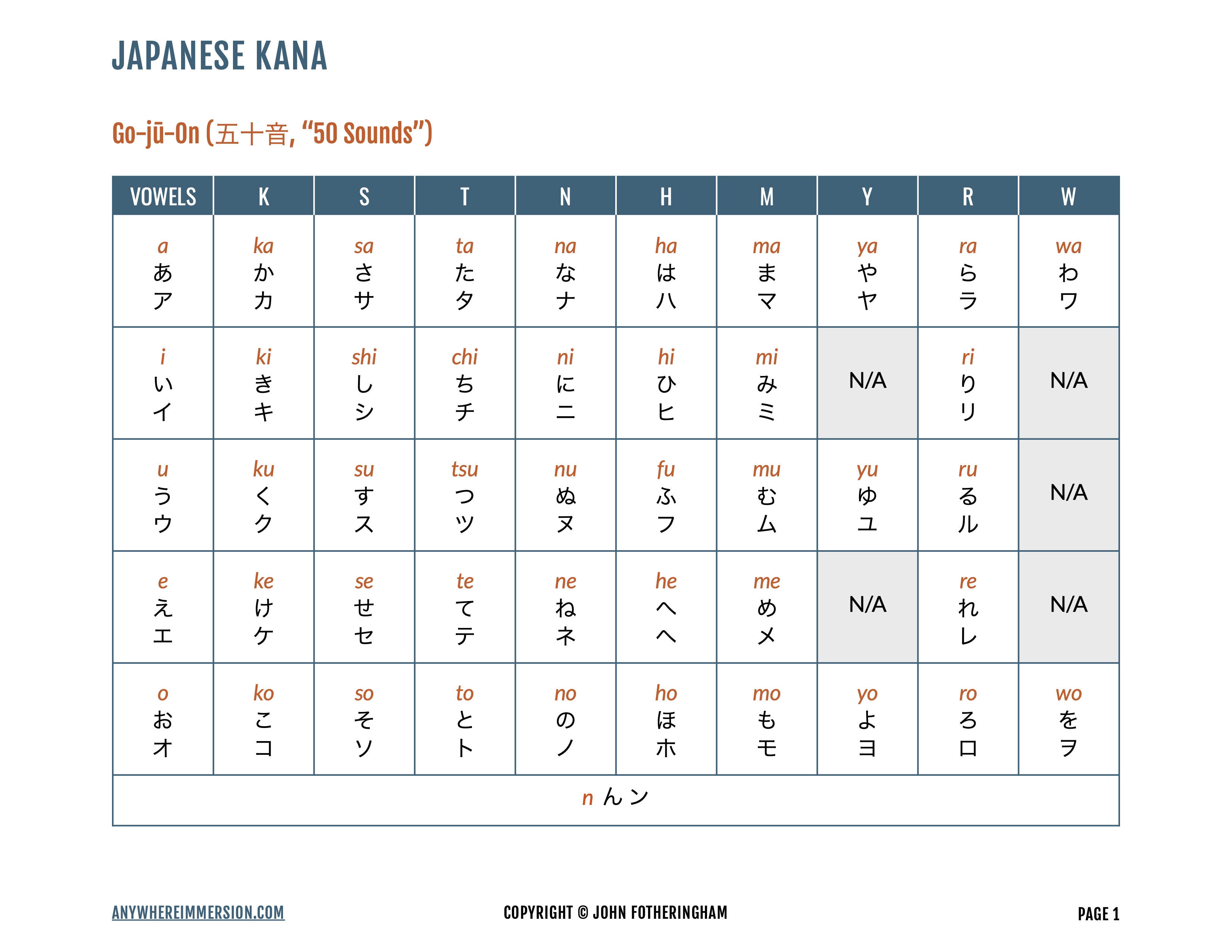
🖨️ Download a print-ready version of this table.
Standard Kana Order
Japanese uses a standard order of kana (similar to how we alphabetize the 26 letters of the English alphabet).
The sequence always begins with the five Japanese vowels from a to o, then the K-column sounds from ka to ko, then the S-column sounds from sa to so, etc., all the way until finishing with the W-column sounds.
Traditionally, the Go-Juu-On is arranged right to left (the direction that you usually read text in Japanese), but I have organized my version of the chart from left to right to make it more intuitive for native speakers of English.
In the table above, I have placed roumaji in the top of each cell, hiragana in the middle, and katakana in the bottom.
Why is N All Alone?
You will notice that n (ん, ン) is chillin’ all by itself at the bottom of the chart.
This is because the sound joined Japanese relatively late in its development under the influence of Chinese vocabulary borrowed into Japanese. Many Chinese syllables end with an n sound, while native Japanese words do not.
For example, all three of the following pronunciations were borrowed into Japanese from Chinese:
san (さん, 三, “three”)
ben-ri na (べんりな, 便利な, “convenient”)
kan-ji (かんじ, 漢字, “Chinese characters”)
Why Are There Empty Boxes in the Chart?
Curious why there are empty spaces in the Go-Juu-On chart? Two of the possible consonant-vowel combinations in the table were used in archaic Japanese, but have since fallen out of use:
ゐ/ヰ (wi)
ゑ/ヱ (we)
But the following three slots have always been vacant:
*yi
*ye
*wu
So the name Go-Juu-On (“fifty sounds”) is obviously more of a convenient narrative than a literal truth.
But as they say:
Why let the truth get in the way of a good story?
Why Learn Kana?
While you eventually need to learn all 2,136 regular-use kanji to be considered fully literate in Japanese (a process that takes most learners years of dedicated study), the good news is that learning kana takes far less time (only 20-30 hours on average). And mastering kana unlocks three key advantages:
Accurate pronunciation: Learning kana helps you learn how to pronounce Japanese syllables correctly. While you can render Japanese in English letters using rou-ma-ji (ローマ字), this can lead to English interference problems and bad pronunciation habits.
Basic literacy: Learning kana is the first step toward Japanese literacy. You will need to know hiragana to read and write grammatical particles, verb endings, etc., and katakana is necessary to write your own name, sound effects, and thousands of modern loan words.
Authentic resources: Without kana, you are limited to boring learner-specific content. Kana unlocks a treasure trove of interesting Japanese resources usually intended for native speakers. For example, many Japanese comic books (漫画) include hiragana reading guides for kanji called furigana (振り仮名).
How to Learn Kana
Before I get to the best way to learn Japanese kana, let me first share the worst way: rote repetition.
Most Japanese teachers and textbooks advise new learners to simply write out each hiragana and katakana symbol over and over, dozens or even hundreds of times. They even sell special workbooks with square grids and writing guides.
While such repetition may help improve your penmanship, it does very little to help you remember kana (especially in cases when you can't copy from a model). This blunt-force approach also happens to be boring as hell, highly ineffective and inefficient, and extremely time-consuming.
Rote memory may be the default approach, but that doesn't mean it's the best.
It turns out that there is a superior method that:
Is far more fun and effective.
Takes much less time and energy.
Aligns with how the adult-brain builds new memories.
What, pray tell, is this magical method?
Mnemonics.
Mnemonics are memory aids that help new information stick through association with existing memories and your unique life experiences.
💡 Fun Fact: The word “mnemonic” is derived from the Ancient Greek word μνημονικός (mnēmonikos), which means “of memory.” That word, in turn, is derived from Mnemosyne, the Greek goddess of memory. In Japanese, mnemonics are called ki-oku-jutsu (記憶術), which literally means "memory techniques."
There are many different kinds of mnemonics, but for our purposes here, you are going to leverage "visual mnemonics" that help you associate each kana with an English letter or word that has similar pronunciation.
Instead of trying to force each kana into your head through tedious rote memory, you will instead leverage the power of association, graphical coincidences, and phonetic cues to make sticky memories you can’t forget!
It's not as quick as plugging into The Matrix, but at least you don't have to drill a hole in the back of your head!
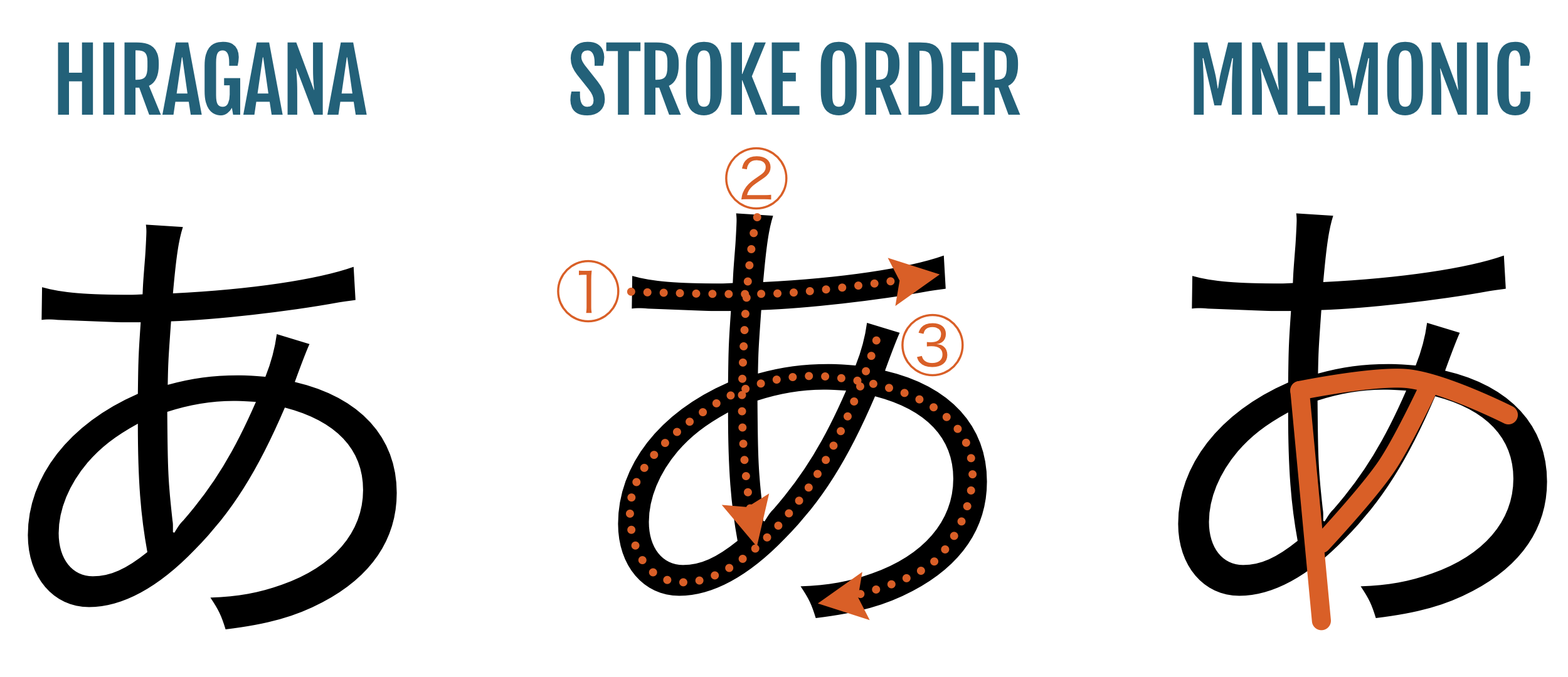
How to Remember the Hiragana あ (A)
For example, take a look at the hiragana あ.
It is pronounced a like in "awe" or "Ah!"
If you look closely, you can actually see the capital letter A hiding inside!
Pretty cool, right?! So cool, in fact, that you just might exclaim "Ah hah!"
It's written as follows:
A horizontal stroke at the top, going from left to right.
A vertical stroke going down the center from top to bottom.
A curlicue stroke starting in the upper-right, moving down to the lower-left, and finishing in the lower-right.
You can see an animated stroke order diagram here.
And now you know your first kana!
Let’s learn a few more.
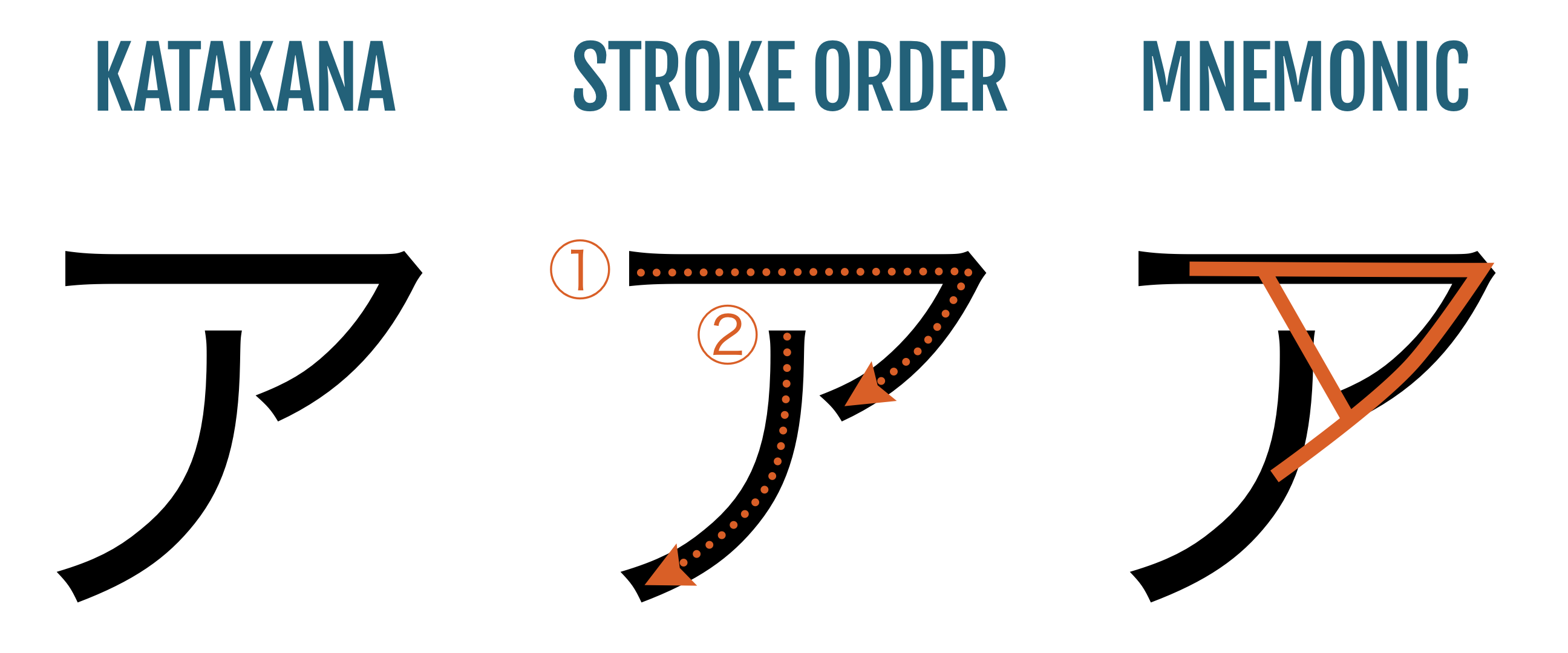
How to Remember the Katakana ア (A)
The katakana version of a has just two strokes:
A hooked stroke starting in the upper-left.
A vertical stroke going top to bottom.
And it turns out that it also has a capital letter "A" hiding inside! Well, sort of...
It's not quite as obvious as the one in the hiragana あ, but it's still a useful mnemonic to help jog your memory. And I think that is pretty AWEsome!
Let's do the next pair of hiragana for the sound I (pronounced like the ee in "see" or "knee").
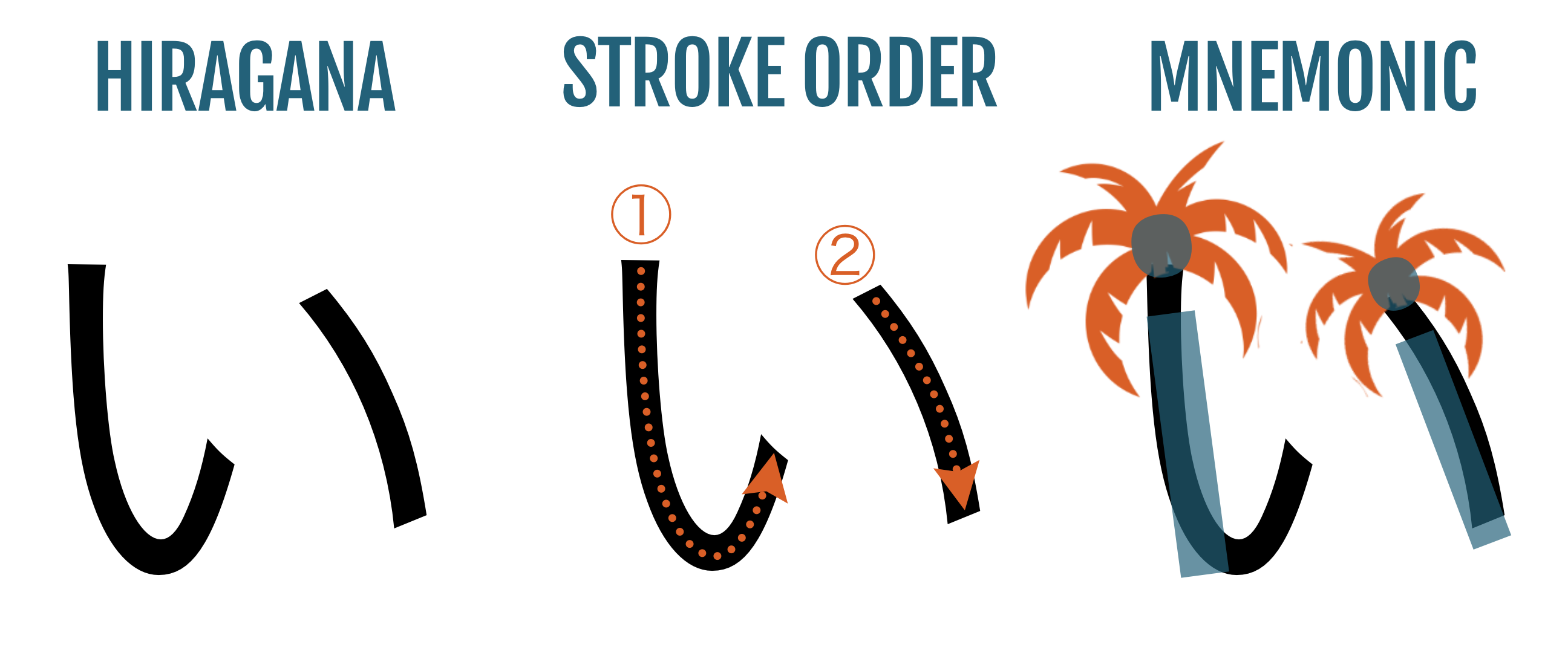
How to Remember the Hiragana い (I)
To help you remember the hiragana い, you're going to take a quick trip to tropical paradise! Picture yourself on the beach in Hawaii, with two giant palm trees, each with the letter i as their trunks.
The hiragana い has two strokes:
First, a downward stroke starting in the upper-left and ending with a little upward hook.
Second, another downward stroke bending slightly toward the lower-right.
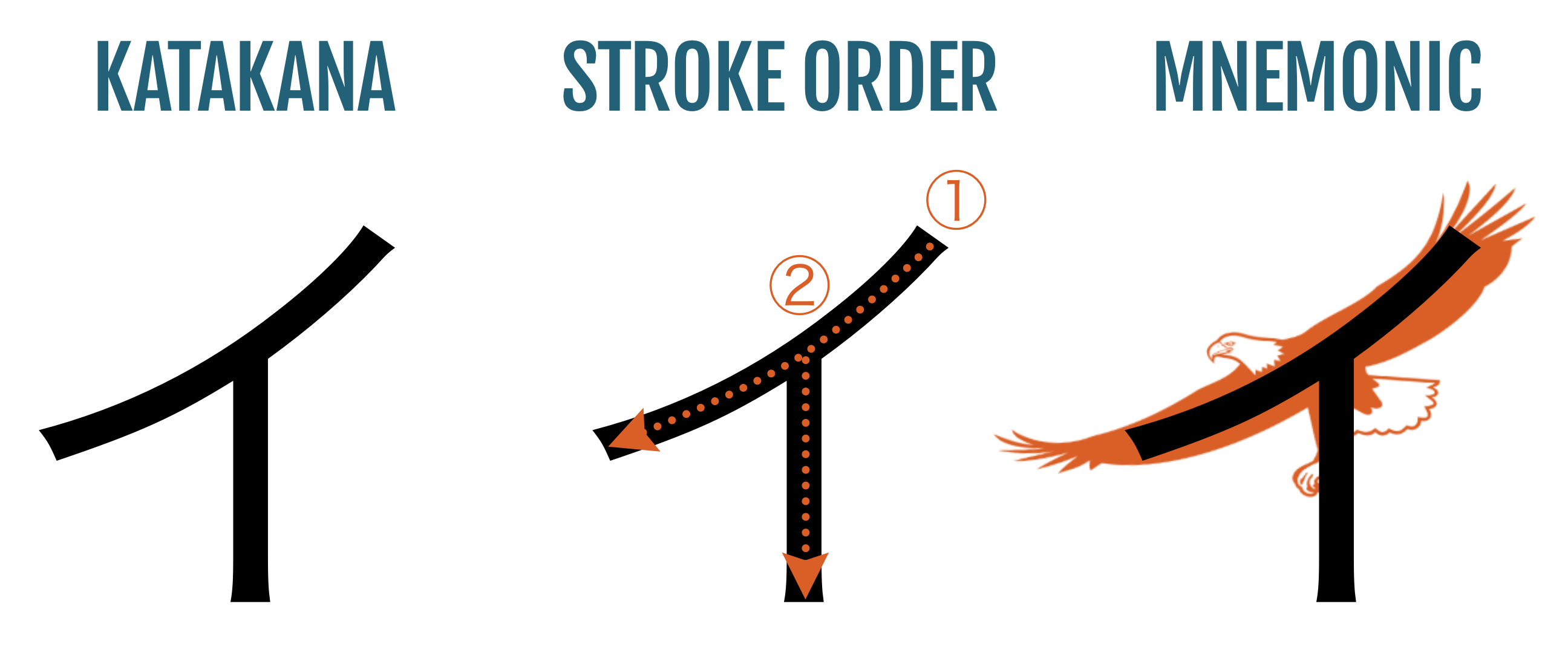
How to Remember the Katakana イ (I)
The katakana version of i also has two strokes:
First, a downward stroke from the upper-right to the lower-left.
Second, a straight vertical stroke down the middle, starting just below the center of the first stroke.
To help you remember the katakana イ, picture a majestic bald eagle soaring through the sky, with its wings outstretched (the first downward stroke from upper-right to lower-left), and its talons hanging down (the second vertical stroke) ready to grab a salmon out of the water.
Learning the Rest of the Kana with Mnemonics
Want to learn the rest of the kana using mnemonics like this?
I am currently building a new Japanese course called the Japanese Immersion Bridge.
It will teach you all of the hiragana and katakana, as well as the essential vocabulary and grammar you need to start understanding authentic content (e.g. anime and manga) and start having flowing conversations.
Join the waitlist here to be the first to know when the course is available (plus get an exclusive discount code)!
Focus on Kana Recognition First
Though I shared the stroke order for these first four kana above, I wouldn't worry too much about handwriting just yet...
In my opinion, most traditional Japanese teachers and textbooks put too much emphasis on learning to write out kana by hand. They assume that the physical repetition will help you remember the kana through muscle memory (it won't) and that handwriting is a foundational skill (it's not).
While Japanese handwriting certainly can be a useful skill to develop down the road (personally, I really enjoy writing things out on paper in my Bullet Journal), you will get the most bang for you buck if you focus your early efforts on learning to recognize kana first.
In the modern world, recognition (being able to quickly decipher the hiragana and katakana you read) is needed far more often than production (being able to write kana by hand). Therefore, I recommend that beginners first focus on learning to read and recognize kana, not stroke order and handwriting. These can come later.
And what is the best way to boost your kana recognition skills?
Extensive exposure to interesting, meaningful Japanese content.
Once you've used mnemonics to memorize the individual kana, spend as much time as possible reading Japanese content. This will help build the foundations of Japanese literacy, create an immediate connection between form and sound, and allow you to immerse yourself in real Japanese.
Here are some suggested kana-heavy resources to focus on as a beginner:
Read the stories in Duolingo's free Japanese course (indicated by an open book icon in the learning path). The stories include a bit of drama to keep things interesting, and are written completely in kana.
Read Japanese children's books. They tend to be written in hiragana alone, include simple language, and provide lots of images to create a clear context.
Read manga, especially shou-nen man-ga (少年漫画, "boys' comics") and shou-jo man-ga (少女漫画, "girls' comics"), both of which include hiragana reading guides next to kanji.
Read news articles on NHK's News Web Easy site, which includes news stories in simple Japanese and displays furigana reading guides above all kanji.
Kana Learning Apps & Books
There are TONS of tools out there to help you learn kana today, but here are just a few of my favorites.
Apps
Duolingo's free Japanese course has an entire section dedicated to learning hiragana and katakana. Click on the あ tab at the bottom of the screen.
Scripts (from the makers of Drops) provides a beautiful, gamified, user-friendly way to practice Japanese hiragana and katakana.
Anki allows you to create custom spaced repetition flashcards for hiragana and katakana, or download a pre-made deck from the community.
Books
Remembering the Kana by James Heisig (the author of Remembering the Kanji) provides a systematic approach to learning to read and write Japanese hiragana and katakana.
Japanese from Zero! 1: Proven Techniques to Learn Japanese for Students and Professionals by George Trombley teaches you all the hiragana (and the basics of the language) through progressive exercises.
Conquer Kana: Learn how to pronounce and write every kana symbol, how to keep look-alike kana straight, and my best tips for self-guided kana study.
12-Day Kana Study Guide
Here now is a recommended self-study schedule to master hiragana and katakana in less than 2 weeks. You can certainly go faster or slower if you like, but I find that 12 days represents a "Goldilocks" pace for most learners.
It provides just enough intensity to see rapid, tangible results.
It's a reasonable pace you can stick to without burning out.
Following this schedule, you will learn roughly 10 new kana most days (5 hiragana and 5 katakana).
I suggest spending spending 30 to 60 minutes per day, broken up as follows:
Upon waking: Spend 10 to 15 minutes reviewing kana from the previous day.
Throughout the day: Use little scraps of time here and there to review flashcards.
Before bed: Spend 15 to 30 minutes learning that day's new kana.
💡 Pro Tip: Learning right before bed is ideal for many language learners since we consolidate new memories while we sleep.
Ready? Let's do this!
Day 1: The 5 Japanese Vowels
On the first day, you will learn the kana for the five vowels in Japanese. You already banged out four of these above!
a = あ・ア
i = い・イ
u = う・ウ
e = え・エ
o = お・オ
Day 2: K-Column Sounds
Learn the K-column kana, which combine an initial K-sound with the same five vowels above:
ka = か・カ
ki = き・キ
ku = く・ク
ke = け・ケ
ko = こ・コ
Day 3: S-Column Sounds
Learn the S-column kana, which combine an initial S-sound with the five Japanese vowels (with the exception of the second kana here which sounds like "she," NOT "see"):
sa = さ・サ
shi = し・シ
su = す・ス
se = せ・セ
so = そ・ソ *
*💡Pro Tip: Be careful not to confuse the katakana so (ソ)with the katakana for n (ン). The stroke order and form are a bit different: For so (ソ), the first stroke is more vertical, and the second stroke goes from top-right to bottom-left. For n (ン), the first stroke is more horizontal, and the second stroke goes from bottom-left to upper-right, the opposite of so (ソ).
Day 4: T-Column Sounds
Learn the T-column kana, which combine an initial T, CH, or TS-sound with the 5 vowels, depending on the kana:
ta = た・タ
chi = ち・チ
tsu = つ・ツ *
te = て・テ
to = と・ト
*💡Pro Tip: We don't have this sound at the beginning of words in English, but we do have a similar sound at the end of words like "rats."
Day 5: N-Column Sounds
Learn the N-column kana:
na = な・ナ
ni = に・ニ
nu = ぬ・ヌ
ne = ね・ネ
no = の・ノ
Day 6: H-Column Sounds
Learn the H-column kana, which combine an initial H- or F-sound with the 5 vowels depending on the kana:
ha = は・ハ *
hi = ひ・ヒ
fu = ふ・フ **
he = へ・ヘ ***
ho = ほ・ホ
*💡Pro Tip: When used as a topic particle, は is pronounced wa (like the kana わ), not ha.
**💡Pro Tip: We don't have this exact sound in English. It's somewhere between an F and H-sound.
***💡Pro Tip: This is the one case in which the hiragana and katakana are written the same!
Day 7: M-Column Sounds
Learn the M-column kana:
ma = ま・マ
mi = み・ミ
mu = む・ム
me = め・メ
mo = も・モ
Day 8: Y-Column Sounds
Learn the Y-column kana, which combine a Y-sound with only the 3 vowels -a, u, and -o.
ya = や・ヤ
yu = ゆ・ユ
yo = よ・ヨ
Day 9: R-Column Sounds
Learn the R-column kana:
ra = ら・ラ
ri = り・リ
ru = る・ル
re = れ・レ
ro = ろ・ロ
💡Pro Tip: The Japanese R-sounds are notoriously difficult for English speakers. Only fair, I suppose, given how hard English Rs and Ls are for Japanese native speakers! In practice, the Japanese R is closer to a D than an American R. You can actually find a similar sound hiding inside of the word "water" (when pronounced with Standard American pronunciation). In this case, the T becomes voiced and is pronounced by quickly tapping the tip of one's tongue against the ridge behind one's teeth. The Japanese R is very similar. For more help, see this helpful video from Tofugu's Koichi.
Day 10: W-Column + N
Learn the 2 W-column kana and the syllable-final N-sound.
wa = わ・ワ
wo = を・ヲ *
n = ん・ン **
**💡Pro Tip: Though written with a W in front, を・ヲ is usually pronounced O by most Japanese people, just like the kana お・オ.
**💡Pro Tip: Again, be careful not to confuse the katakana n (ン) with the katakana for so (ソ).
Day 11: Voiced Sounds
You may have noticed that the Japanese consonants G, Z, and D are nowhere to be found on the Go-Juu-On chart above…
Did I forget them? Nope!
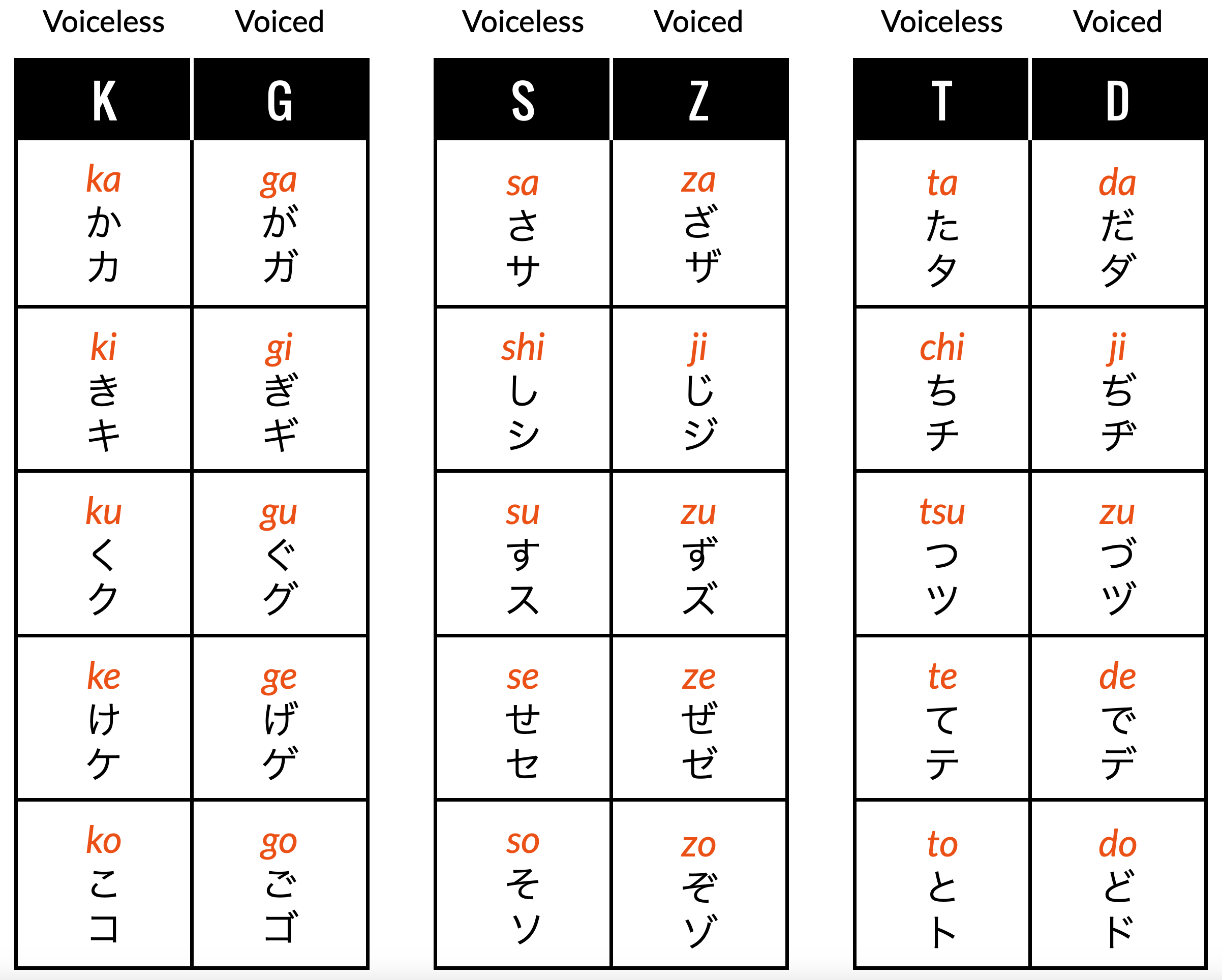
It turns out that Japanese has a nifty trick that reduces the total number of kana you have to learn. Instead of having to learn two separate hiragana for ka and ga, for example, you can simply attach a diacritic mark called a daku-ten (濁点, “voiced mark”).
Because of this, the hiragana for K and G sounds, S and Z sounds, and T and D sounds are ALL exactly the same, differentiated only by two little slash marks in the upper-right corner:
ka = か・カ → ga = が・ガ
sa = さ・サ → za = ざ・ザ
ta = た・タ → da = だ・ダ
In the same way, you can transform all the other “voiceless” consonants into their “voiced” phonetic sisters. Cool, right?!
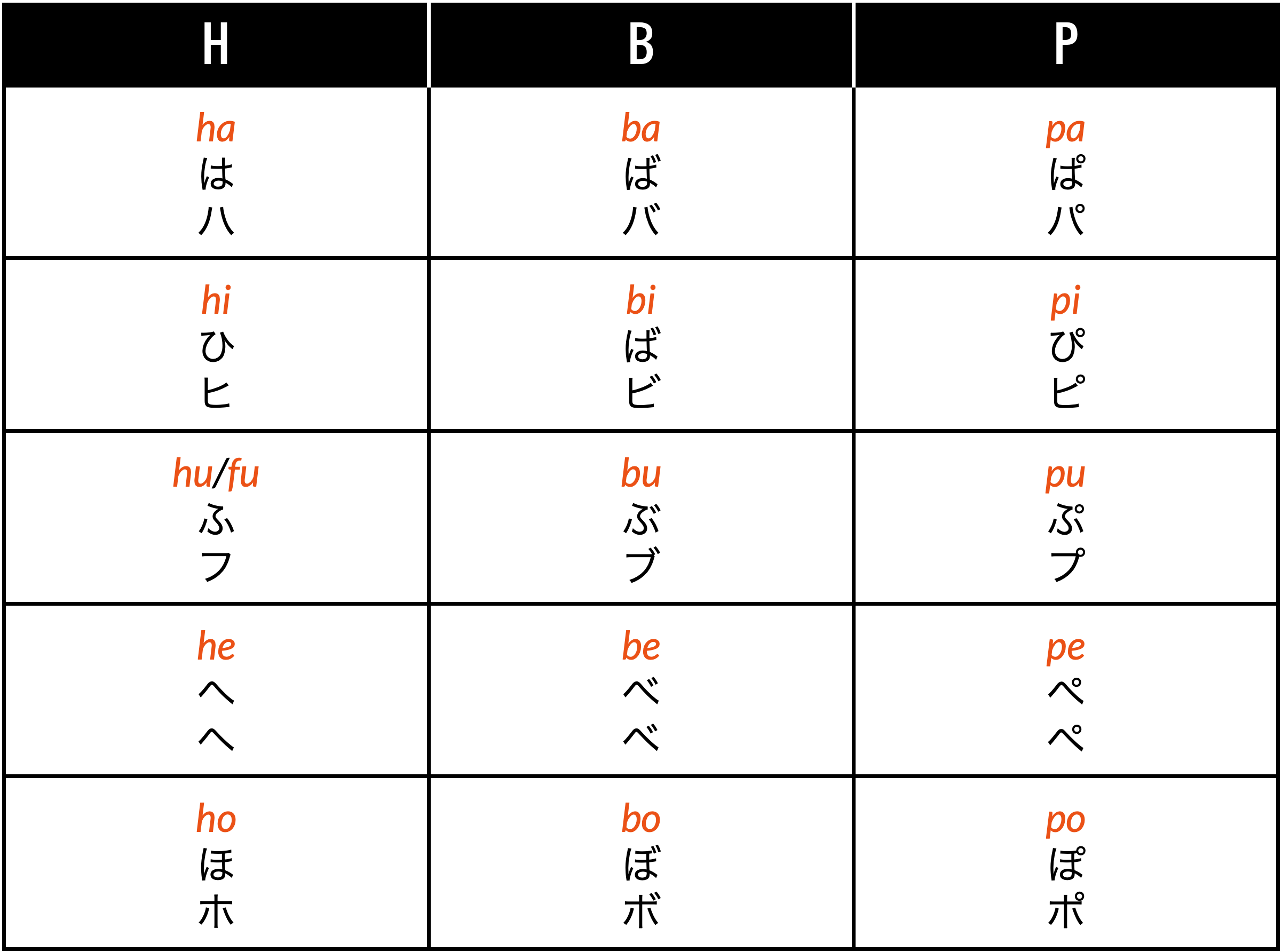
If you are really astute, you probably noticed that the Go-juu-on also lacked kana for B and P sounds. Once again, this was not an omission, but rather one more way in which Japanese makes your life a bit easier by reducing the total number of symbols you have to learn!
In this case, Japanese uses the same daku-ten slashes we saw above to transform H kana into B kana (e.g. ha は becomes ba ば), and a little circle symbol called a han-daku-ten (半濁点, “half voiced mark”) to transform H kana to P kana (e.g. ha は to pa ぱ).
Despite the Japanese terms, this is not actually a voiceless/voiced distinction since H and P sounds are both voiceless, and H and B are pronounced in different parts of the mouth and are not "minimal pairs" like the K/G, S/Z, and T/D pairs above.
Here's the complete table.
Since this day is a bit of a freebie, spend a little extra time reviewing the kana you’ve learned so far.
Day 12: Palatalized Sounds
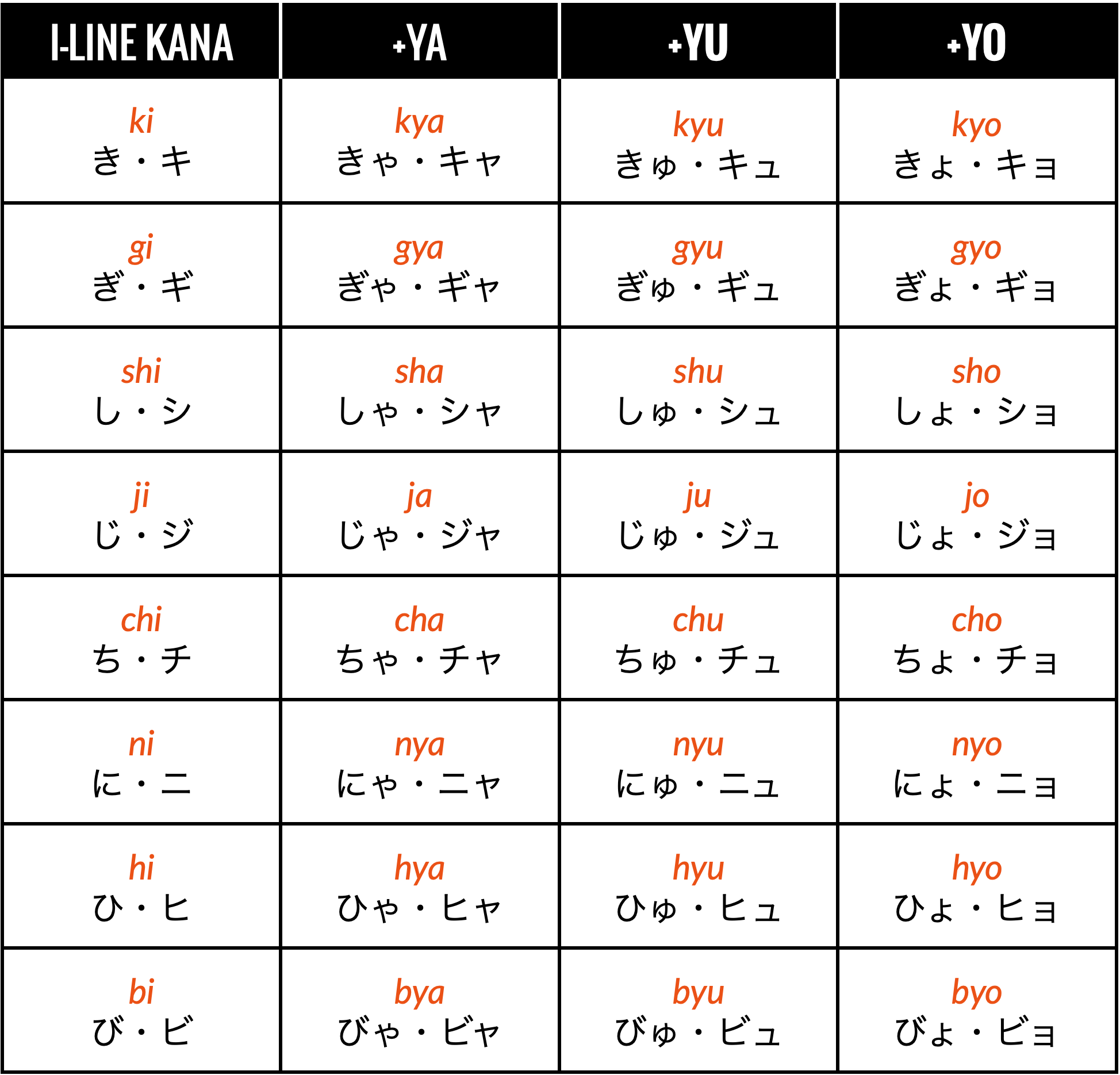
Japanese also has a set of “palatalized” sounds called you-on (拗音) which combine kana from the I-row with those from the Y-column. As you will see, the Y-column part uses small kana symbols (e.g. kya is written きゃ, not *きや).
And that's all the kana!
It may seem overwhelming at first to learn so many new symbols, but with consistent daily practice, an adult-friendly approach, and the right tools, you can conquer kana in just a few weeks (or even over the weekend if you really push yourself)!
And once you can recognize hiragana and katakana, you can start to enjoy the wild world of authentic Japanese resources.
This is a major step in your journey to master the Japanese language and deepen your understanding of the Japanese culture.
The choice is yours:
Do you want to take the red pill and enter the world of REAL Japanese?
Or will you take the blue pill and stay locked in the boring world of textbooks?

About the Author
Hi, I’m John Fotheringham, a linguist, teacher, author, and the creator of the Anywhere Immersion Method™ (or A.I.M. for short).
Whether you are dipping your toes into the linguistics waters for the first time or are ready to dive into the deep end of full language immersion, I will give you the tips and tools you need to succeed (and not feel like you’re drowning along the way).
My blog, books, courses, and newsletter provide the expert guidance you need to learn any language, anywhere, anytime through the power of immersion.
Happy diving!
🤿 Get my best immersion tips + tools 🐠
Join my free Fluency Friday newsletter to get the tips and tools you need to get fluent anywhere in the world.
Download my Free
Immersion Guide
My free Quickstart Immersion Guide shows you how to immerse yourself in any language, anywhere, anytime. You'll learn:
Which essential tools to use.
How to boost comprehension.
How to get fluent right at home.
How to master your mindset.