- Jan 29, 2025
3 Ways to Supercharge Your Memory, Get Fluent Faster & Remember New Words Forever
- John Fotheringham
- Tips & Tools
Ever wonder why your brain seems to be more like a leaky bucket than a memory vault?
Contrary to what you might believe, the problem isn't having a "bad memory." Barring severe neurological problems, your brain is doing precisely what it evolved to do: encode essential information and ignore the rest.
If your brain did happen to remember every bit of information it was exposed to in your daily life, you'd quickly get overwhelmed. Worse yet, you would miss the signal amid all the noise, and your chances of surviving and thriving would go down the toilet.
You may wish that you could automatically recall everything you read, remember the name of everyone you meet, and easily memorize an entire Japanese dictionary. But as they say, be careful what you wish for.
The goal in life (and language learning!) isn't the mere accumulation of information. The goal is communication and connection. And simply remembering a bunch of facts will not allow you to communicate and connect with other humans.
Though some individuals possess exceptional abilities like photographic memory and verbatim recall, such gifts are rare.
And the good news is that you don't have to be a savant to accomplish impressive feats of memory. Here are three effective ways to significantly improve your retention and recall.
Increase "salience" through context and emotional connection.
Use spaced repetition to hack your brain and boost your memory.
Get repetition without boredom through "narrow reading" and "narrow listening."
① Boost Memory with Context & Emotional Connection
When you truly enjoy something, your brain is more likely to spend the resources required to build new neural connections and thicker layers of myelin (a fatty substance that wraps around nerve fibers to speed up electrical signals).
Pleasurable experiences are also more likely to be repeated over and over, which provides the repetition and salience your brain requires to encode new memories and recall previous memories.
Add all of this together, and you get the thing every language learner wants: fluency.
But enjoyment alone is not enough to get fluent. You also need to learn in context and understand the gist of what you are hearing and reading. As the linguist Stephen Krashen argues in his "input hypothesis":
"We acquire language in only one way: when we understand messages."
He calls such messages "comprehensible input" (reading and listening content that is at or just beyond our current language level).
And a big part of comprehension is context.
Instead of learning lists of random words in isolation (which is as boring as it is ineffective!), focus on learning in context by consuming "authentic content" (materials created for native speakers instead of language learners).
Instead of textbooks, think comic books.
Instead of classes, think TV series.
This is precisely what my Anywhere Immersion Method is all about and exactly what I cover in my books Master Japanese: How to Learn Japanese Anywhere in the World and Master Mandarin: How to Learn Mandarin Chinese Anywhere in the World.
Learning this way has numerous advantages over traditional language education. Here are the top three:
You'll develop more useful and nuanced knowledge: Learn how words and structures are actually used out in the wild.
You'll create stickier memories: The vivid visuals and compelling narratives all help with deeper encoding.
You'll boost consistency: You'll want to keep coming back to find out what happens in the story.
But don't forget the comprehensible part of "comprehensible input." Content won't be very interesting if you can't make heads or tails of it. And you won't learn much if it's way to far beyond your current level.
As Krashen puts it:
"Language acquisition proceeds best when the input is not just comprehensible, but really interesting, even compelling; so interesting that you forget you are listening to or reading another language."
Here are some useful ways to increase understanding, enjoyment, and retention:
Read plot summaries: Before you watch a show or read a book, read plot summaries on Wikipedia or IMDB. This may spoil some of the surprise, but it will let you learn more and better enjoy the journey.
Leverage AI tools: Any time you are confused about what is happening in a story, who a character is, or the significance of certain events, simply ask for clarity using tools like ChatGPT or Claude.
Use interactive subtitles: Tools like Language Reactor, Lingopie, Migaku, and Language Player add supercharged subtitles/captions to videos on Netflix, YouTube, etc. so you can quickly look up and save new vocabulary.
② Use Spaced Repetition to Hack Your Brain
In the late 1800s, a German psychologist named Hermann Ebbinghaus (1850-1909) completed a series of personal "N of 1" experiments on memory. He later published his findings in a paper titled Über das Gedächtnis (dubbed Memory: A Contribution to Experimental Psychology in English).
Though his “research” was limited in scope and generalizability given the tiny sample size, his basic findings have since been reproduced in more rigorous scientific studies.
And what was the key takeaway from his research?
New information is forgotten REALLY fast.
This may be the ultimate "duh!" conclusion, but it has important consequences for language learning.
As you can see in Ebbinghaus's "forgetting curve" below, he forgot new information almost immediately, with over half of the target information lost in just the first hour and nearly ¾ within 24 hours!
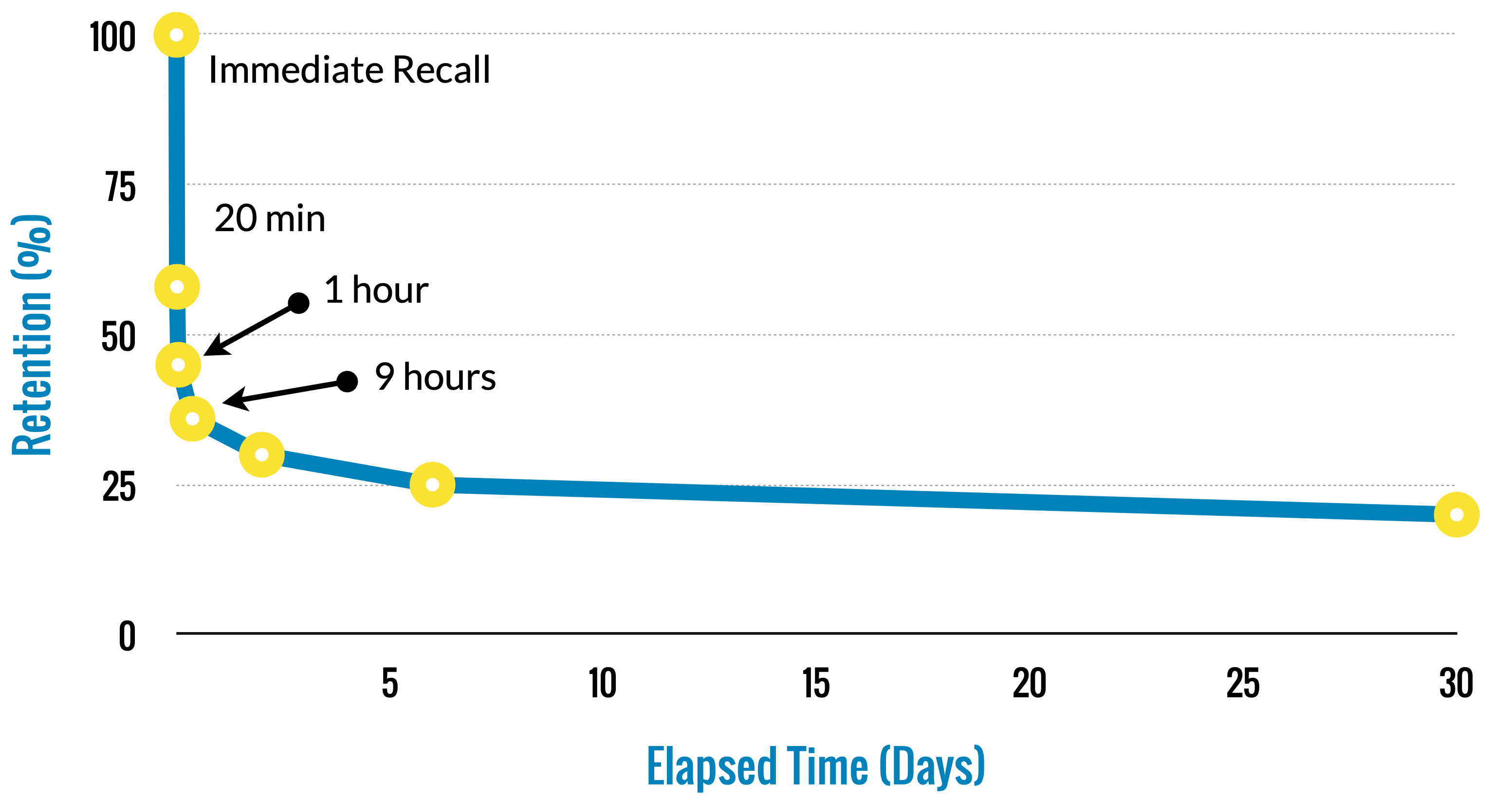
You have likely experienced the same rate of forgetfulness in your own language studies. I certainly did before I changed how I learn.
Fortunately, there is a proven way to prevent such rapid forgetting and encode information in your brain for long-term retention: repetition.
Each time you re-expose your brain to a given piece of information, it resets and remolds the forgetting curve. Each rep tells your brain:
"Hey, this information is important. Don't forget it!"
But repetition alone won't work.
Consider these two common approaches to language study:
You go through a list of vocab words over and over, saying them aloud and trying to make them stick. Then you cover the target language part and try to quiz yourself from the English translations. Much to your chagrin, you discover that almost all of the words have already disappeared from memory. Ebbinghaus' forgetting curve strikes again!
You try to commit a dozen new Japanese kanji to memory by writing them over and over again on a piece of paper. You desperately hope that the rote repetition, visual focus, and muscle memory will make the characters stick. But when you flip the paper over to test yourself, you realize you are grasping at straws, unsure where to start or which squiggles go where.
These are perfectly normal and predictable outcomes given these approaches. It turns out that both of these methods are highly ineffective despite their ubiquity in language education. The truth is that:
You need to practice producing information from memory, not simply looking at information again and again or copying a character stroke by stroke while looking at a model.
You need to space out repetitions over longer and longer periods of time. Immediately reviewing the same information stores it in short-term memory, not the long-term encoding we're after in language learning.
Using a spaced repetition system (or "SRS" for short) solves both of these problems:
If you create your flashcards properly (more on this below), the system will ask you to produce the answer from memory. You can then check if you were right or wrong when you flip the digital card over.
The app's algorithm with automatically space out repetitions based on how well you rate your knowledge. Easier cards are pushed back and shown less often, while harder cards are repeated sooner and with higher frequency.
Get the Anki SRS App
Many language apps today integrate some level of spaced repetition, but the most powerful and customizable SRS app is called Anki. For a deep dive into using the and personalizing your flashcards, see my post Rapidly Expand Your Foreign Language Vocabulary with These 7 Expert Anki Tips.
💡 Fun Fact: The word "anki" (暗記) means "memorization" in Japanese.
Keep in mind, however, that although a good spaced repetition system with effective, personalized flashcards can help a lot, flashcards alone are not going to get you fluent. Nor are they going to sustain your motivation and interest. Remember: salience is essential. Always return to interesting, authentic content. Which brings us to the final memory-boosting strategy I'd like to highlight.
③ Use "Narrow Reading" & "Narrow Listening" to Get Repetition without Boredom
A love for repetition is perhaps one of the biggest advantages children have when learning their first language. I am simply amazed how my nieces and nephews can watch the same Sesame Street episode or read the same Dr. Seuss book a zillion times without getting bored.
We adults, on the other hand, quickly burn out on content. We may watch the same Christmas movie every year, but we'd see watching the same foreign film every week as a form of punishment, not pleasure. Such repetition would feel like being stuck in a linguistic Groundhog Day, minus Bill Murray's charm.
Fortunately, there is a way to eat our "repetition cake" without having to stomach the "boredom broccoli" along with it. It's called "narrow reading."
The idea, popularized by Stephen Krashen, is simple yet effective. All you have to do is read multiple articles, blog posts, books, etc. on the same narrow topic. Or you can try the sister approach of "narrow listening" by consuming podcasts, YouTube videos, documentaries, etc. focused on the same specific theme.
Doing so will:
Provide valuable exposure to the same high-frequency words again and again.
Create useful background knowledge that increases comprehension and interest.
Develop a more nuanced understanding of the topic and how native speakers discuss it.
Simply pick your favorite hobby (whether it's gardening, gaming, or gossip) and dive into resources written or recorded in your target language.
Here are three specific scenarios to give you a better idea of what this looks like in practice.
Fútbol Fanatic
Let's say you're a soccer-obsessed person learning Spanish. Instead of forcing yourself through a dry libro de texto, you could instead:
Read soccer match reports from sports websites and news outlets written en español.
Watch post-game interviews with Spanish-speaking players on YouTube.
Listen to Spanish-language soccer podcasts on Apple Podcasts or Spotify.
Follow Spanish-speaking players on social media.
Read player biographies in Spanish on Wikipedia.
You'll naturally encounter useful, high-frequency terms like gol ("goal"), balón ("ball"), and partido ("match") again and again, but in fresh, engaging contexts. It's like meeting the same friend in different coffee shops — familiar face, new setting!
Master Chef
Or perhaps you a Japanese learner who loves cooking. You can find tons of Japanese cooking shows online, and Netflix alone has multiple food-related shows, including:
Samurai Gourmet (野武士のグルメ)
Midnight Diner (深夜食堂)
Japanese Style Originator (和風総本家)
As you watch different chefs prepare sushi, ramen, and beyond, you'll effortlessly absorb cooking vocabulary without even realizing it. Before long, you will have mastered:
Culinary verbs like yaku (焼く, "grill"), kizamu (刻む, "chop"), and itameru (炒める, "stir-fry/sauté").
Ingredients like shō-yu (醤油, "soy sauce"), miso (味噌, "fermented soybean paste"), and da-shi (出汁).
Flavors like ama-mi (甘味, "sweetness"), en-mi (塩味, "saltiness"), and uma-mi (旨味, "savoriness").
Talk about a tasty way to learn!
And as Krashen would say, this is "comprehensible input" at its finest.
Amateur Journalist
One of the best ways I've found to apply narrow listening and reading, while also getting some speaking practice to boot, is interviewing a number of native speakers using the same predefined questions. It's like being a language learning journalist!
Even if you don't live where the language is spoken, you can find thousands of native speakers online using tutoring sites like italki. Each conversation will be unique, but the core vocabulary will keep popping up (it's repetition in disguise)!
The Bottom Line: Your brain resists rote repetition but it loves picking out patterns in engaging content. So do everything you can to increase your emotional connection, use intelligent spacing to hack your memory, and give yourself permission to nerd out on your narrow interests.
And if a language teacher every instructs you to memorize a vocabulary list, you can quote Krashen and say, "I prefer to acquire language through compelling comprehensible input." (And yes, that's totally a phrase you can drop at cocktail parties to sound impressively scholarly!)
About the Author
Hi, I’m John Fotheringham, a linguist, teacher, author, and the creator of the Anywhere Immersion Method™ (or A.I.M. for short).
Whether you are dipping your toes into the linguistics waters for the first time or are ready to dive into the deep end of full language immersion, I will give you the tips and tools you need to succeed (and not feel like you’re drowning along the way).
My blog, books, courses, and newsletter provide the expert guidance you need to learn any language, anywhere, anytime through the power of immersion.
Happy diving!
🤿 Get my best immersion tips + tools 🐠
Join my free Fluency Friday newsletter to get the tips and tools you need to get fluent anywhere in the world.
Download my Free
Immersion Guide
My free Quickstart Immersion Guide shows you how to immerse yourself in any language, anywhere, anytime. You'll learn:
Which essential tools to use.
How to boost comprehension.
How to get fluent right at home.
How to master your mindset.