- Jan 8, 2025
Want To Get Fluent in Japanese Through Immersion? Follow These 11 Principles
- John Fotheringham
- Japanese, Tips & Tools
Immersing yourself in Japanese is one of the most effective ways to become fluent, but it’s not as simple as flipping a switch or downloading an app. True fluency takes time, effort, and the right mindset. I don’t care how cool your tools are; without the right attitude, you won’t get very far up Japanese Mountain. That’s where the right language learning principles come in.
As Ralph Waldo Emerson put it:
“As to methods there may be a million and then some, but principles are few. The man who grasps principles can successfully select his own methods. The man who tries methods, ignoring principles, is sure to have trouble.”
Or in the wise words of Scott H. Young in his book Ultralearning: Master Hard Skills, Outsmart the Competition, and Accelerate Your Career:
“Principles allow you to solve problems, even those you may have never encountered before, in a way that a recipe or mechanical procedure cannot . . . Principles make sense of the world, and even if they don’t always articulate exactly how you should solve a particular challenge, they can provide immense guidance. Ultralearning, in my view, works best when you see it through a simple set of principles, rather than trying to copy and paste exact steps or protocols.”
From making learning fun and adventurous to embracing the discipline and sacrifice needed to stay consistent, the following principles are your guide to mastering Japanese through my Anywhere Immersion Method. Whether you’re just starting out or looking to take your skills to the next level, this post will show you how to make your journey as direct, enjoyable, and rewarding as possible.
Ready to dive in? Here now are the primary principles you need to reach fluency in Japanese, stick to your habits, and better enjoy the journey. And like the amplifier in the mockumentary This Is Spinal Tap, my list goes to 11!
Learning should be as direct as possible.
Learning should be as fun as possible.
Learning should be an adventure.
Learning requires patience and presence.
Learning requires persistence.
Learning requires discipline.
Learning requires sacrifice.
Learning requires making mistakes.
Perfectionism is the enemy of progress.
There is no one way to learn.
Time and attitude trump talent and aptitude.
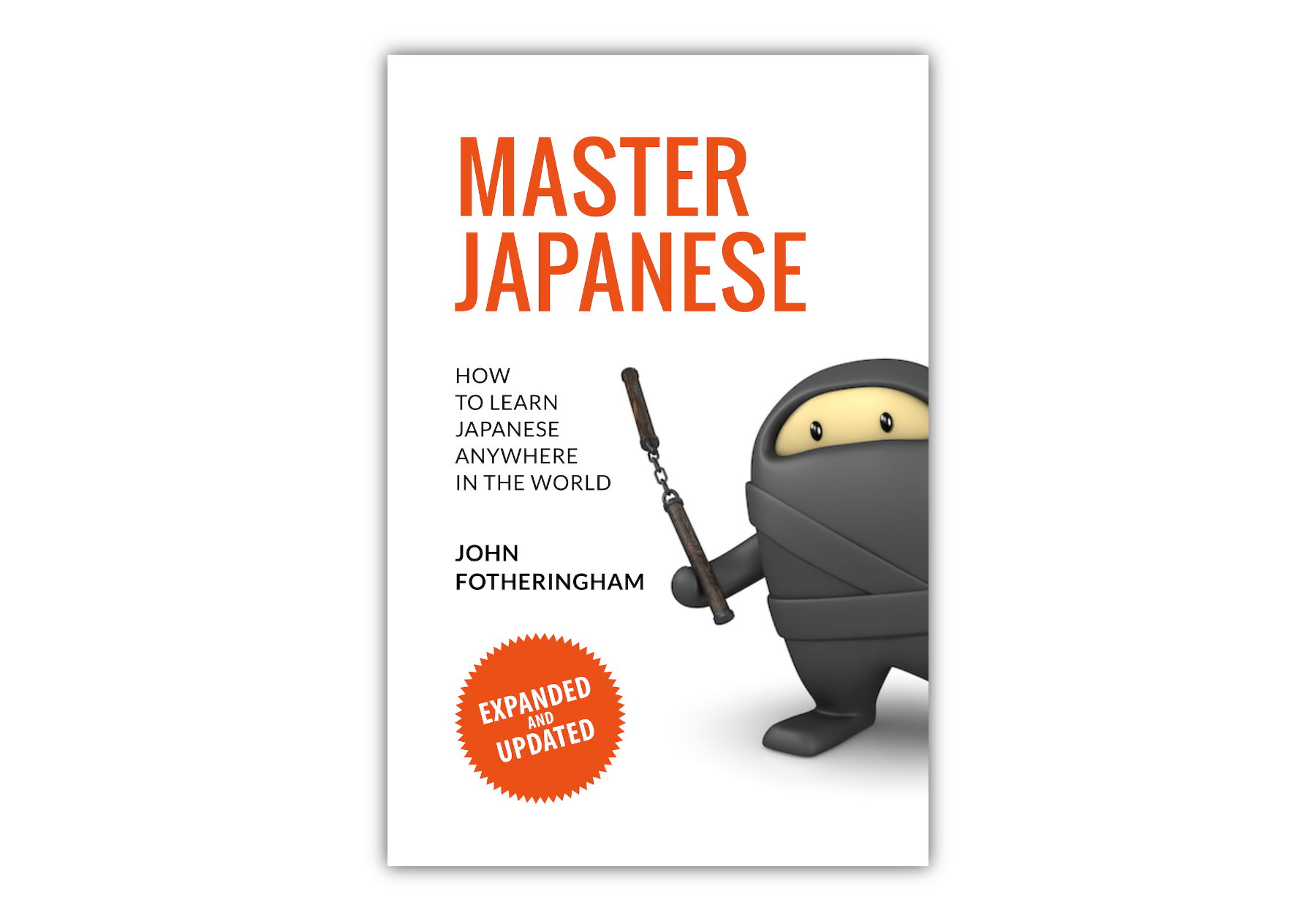
💡 This blog post is an excerpt from my book Master Japanese: How to Learn Japanese Anywhere in the World.
Learning Should Be as Direct as Possible
“Learn by doing the thing you want to become good at. Don’t trade it off for other tasks just because those are more convenient and comfortable.” ―Scott H. Young, Ultralearning
If you only remember one principle from this list, make it this: Directly practice the skills you want to improve. For example, if you want to be able to speak well, you have to practice speaking directly.
Sounds simple and obvious, right? Well, in practice, the vast majority of Japanese language learners do anything but practice the language directly. Why? Directness often requires stepping out of one’s comfort zone and into uncertainty and ambiguity.
Whether studying in a traditional classroom or using modern apps, the vast majority of time is spent passively learning about Japanese instead of actively practicing in Japanese. Instead of immersing oneself in authentic content and communicating with native speakers, time is spent memorizing and procrastinating.
Can a little vocab and grammar study be a helpful supplement? Sure. But it’s no substitute for hearing, speaking, reading, and writing the language.
You can’t reach fluency in a language unless you actually use it.
If you want to get good at understanding spoken Japanese, you have to actually practice listening to the spoken language at natural speed.
If you want to get good at speaking Japanese, you have to actually move your tongue, lips, teeth, and larynx and practice stringing words together aloud in real time.
If you want to get good at reading Japanese, you have to actually consume authentic written content in the language, whether online, on your phone, or in a book.
If you want to get good at writing Japanese, you have to actually practice constructing novel sentences and communicating ideas on paper or screen.
Moreover, do your best to practice in the exact kind of environment you intend to use Japanese day-to-day. Again, we get better at what we train most, so try to match your training environment to your performance environment.
One of the best examples of this is recounted in Brain Rules: 12 Principles for Surviving and Thriving at Work, Home, and School by John Medina. In an unusual experiment, a group of deep sea divers was asked to recall 40 random words they heard either standing in 10 feet of water or while standing on the beach in their wetsuits. It turns out that their ability to recall the words was significantly affected by where they heard the words and where they were asked to recall the words.
The divers who heard the words while bobbing in the water were able to later recall the words with 15% more accuracy if they were tested again while in the water instead of on dry land.
Conversely, the group who heard the words on dry land also recalled the words with 15% more accuracy when out of the water.
Clearly, context and environment are extremely important. As Medina puts it:
“It appeared that memory worked best if the environmental conditions at retrieval mimicked the environmental conditions at encoding.”
This is yet one more reason that traditional classroom and textbook learning is so ineffective: it is completely removed from the real-life, human-to-human communication scenarios in which learners will later find themselves. You can study for years, consciously memorize mountains of out-of-context vocabulary, and still struggle (ahem... panic!) the first time you need to comprehend and respond to real, rapid-fire speech.
As the ancient Greek poet Archilochus once said:
“We don't rise to the level of our expectations, we fall to the level of our training.”
So if you will be conducting business with Japanese firms over the phone, for example, make sure to get lots of practice speaking in Japanese on the phone. Don’t wait until the day of an important meeting or sales call to find out just how different communication can be without visual cues! Remember: we get better at what we practice directly. So if you want to get good at speaking on in Japanese on the phone, you need to practice that skill head on!
💡 Pro Tip! To improve your listening skills without the aid of visual cues, facial expressions, body language, etc., try turning off your webcam when speaking with your Japanese tutor.
Take Action!
Take an honest look at how you really spend your time each week:
How many hours are you directly, actively practicing Japanese each week?
How many hours are you passively studying about Japanese in English? How can you make your study time more direct?
What are the important but uncomfortable activities you are avoiding?
💡 Pro Tip! Use an app like ATracker to track your time for 2+ weeks.
Learning Should Be as Fun as Possible
“Why do so many frown so sternly at the idea of having fun? Perhaps out of fear that it connotes you aren’t serious. But best we can tell, there is no correlation between appearing to be serious and actually being good at what you do. In fact, an argument can be made that the opposite is true.” ―Steven Levitt & Stephen Dubner, Think Like a Freak
During my time studying linguistics and languages at university, teaching adults in the U.S., Japan, and Taiwan, and working in both the private and public sectors, one peculiar theme has stood out to me:
Most people believe one has to be serious to be effective.
For whatever reason, the majority of grownups believe that having fun is reserved for children. Past a certain age, the assumption goes, we have little time nor need for playfulness.
If Dr. Seuss were to sum up the sentiment, he probably would have said:
We have families to feed and mortgages to pay.
There’s no time for games.
No need for play.
We adults certainly do have more responsibilities than children, but who ever said that being responsible requires being serious? The truth is that fun, play, and curiosity lead to a higher―not lower―level of performance.
Play Gives You a Better Brain
“Nothing fires up the brain like play.” ―Dr. Stuart Brown, founder of The National Institute for Play
Play improves brain function, neural plasticity, adaptability, creativity, and memory. All of this makes new Japanese words, characters, structures, and concepts far “stickier.” In short, the more you play, the better you learn.
Play increases motivation
“To get it done, make it fun.” ―Gretchen Rubin, Outer Order, Inner Calm
If you love the process of learning a language, you’ll want to do more of it. It will be the first thing you think about when you open your eyes in the morning, and the last thing you think about when closing your eyes at night. Spending time immersed in Japanese will become a treat instead of a chore.
Learning Should Be an Adventure
“It is fatal to know too much at the outset. Boredom comes as quickly to the traveler who knows his route as the novelist who is over certain of his plot.” ―Paul Theroux
True adventures are difficult.
They’re risky.
And they’re uncertain.
You won’t always know where you’re going. And even when your destination is clear, you won’t always know how you will get there or whether you will arrive. If you do have such certainty, then you are on a trip, not an adventure.
It’s important to have aims and goals, but understand that part of the joy of learning a language is embracing the inevitable uncertainty and wonderful serendipity that a "hero's journey" entails.
Learning Requires Patience & Presence
“Patience, persistence, and perspiration make an unbeatable combination for success.” ―Napoleon Hill
Patience and presence are two of the sharpest tools in the language learner’s toolbox. And this is perhaps more true of Japanese than almost any language given the paramount importance of reserve, self-control, and emotional endurance in Japanese culture.
Just as Rome was not built in a day, nor will you master Japanese with one turn of the earth. If you learn in a fun, effective way, you can certainly reach conversational fluency at a relatively quick clip. But realize that such a pace requires complete focus and dedication to your Japanese mission. On a daily basis, you will need faith that your approach is working and that your effort will pay off, since you won’t be able to see or feel much improvement in the moment.
Another key aspect of patience is keeping your cool when you make mistakes, don’t understand what’s being said, or others struggle to comprehend your utterances. Losing your patience will make it even more difficult to communicate, will likely sour relationships, and perhaps worst of all, will cause you and those around you to “lose face,” or men-boku wo ushinau (面目を失う).
If you start getting frustrated, just take three deep, conscious “belly breaths,” making sure that your abdomen expands, not just your chest. If done correctly, this will create a cascade of positive psychological and physiological effects that will put you at ease and help you better communicate.
Mastering a language also requires being completely focused on what you are currently learning, hearing, saying, or reading. The more time you spend actively engaged with the language in the present moment, the faster you’ll learn.
Learning Requires Persistence & Consistency
“The most useful form of patience is persistence. Patience implies waiting for things to improve on their own. Persistence implies keeping your head down and continuing to work when things take longer than you expect.” ―James Clear, 3-2-1 Thursday Newsletter
While patience and presence are crucial, please understand that I am not advocating inaction or laziness. On the contrary.
Nor I am encouraging sporadic, occasional, all-out efforts. Success in a language requires consistent, quotidian progress.
The problem? This is far less sexy than the zero-to-hero stories we see in the movies. We humans love a good story, and one of our favorite narratives is seeing an underdog struggle to overcome a personal weakness or defeat an evil foe. In movie format, such stories inevitably include two cinematic clichés:
A training montage: The protagonist goes from zero to hero in the span of a single high-energy song. In the first clip, they keep missing the speed bag or it bounces back and hits them in the face. Fast forward three minutes, and they are now throwing perfectly timed hand-over-hand punches while wearing a blindfold, standing on one leg, and whistling Dixie.
A climactic battle or showdown: All of the protagonist’s previous training and experience are put to a final test, a single, decisive moment that makes or breaks the character. Just when it seems that the hero is about to be killed or defeated, they dig down deep into their soul and give their last ounce of strength to clinch victory.
While learning Japanese is indeed a hero’s journey that will test your heroic mettle at times (watch The Power of Myth for more about this), it’s important to understand that language acquisition is fueled by small, steady, incremental steps, not heroic leaps. As James Clear notes in his book Atomic Habits:
“It is so easy to overestimate the importance of one defining moment and underestimate the value of making small improvements on a daily basis. Too often, we convince ourselves that massive success requires massive action."
Persistence and gradual progress are not exactly fodder for a high-grossing blockbuster movie plot, but they are what build truly impressive results in the real world.
In fact, such compounding is the secret to long-term growth and progress in every worthwhile endeavor, from learning Japanese, to financial investing, to martial arts. You may not perceive much progress in your Japanese skills, wealth, or physical skills on any given day, but if you keep at it, you will be amazed how high your “marginal gains” (small, incremental improvements) will stack up over time. As James highlights with this staggering yet unintuitive math:
"… if you can get 1 percent better each day for one year, you’ll end up thirty-seven times better by the time you’re done.”
Though we don’t make progress through one-off heroic efforts, we do occasionally feel or perceive sudden, drastic changes. But it’s important to understand that these are but the visible downstream effects of hundreds of thousands of previous “habit dominoes” that had to fall first. To illustrate this point, James uses the analogy of ice melting:
“Complaining about not achieving success despite working hard is like complaining about an ice cube not melting when you heated it from twenty-five to thirty-one degrees. Your work was not wasted; it is just being stored. All the action happens at thirty-two degrees.”
Even when you can't see your “Japanese ice cube” melting in the moment, know that the work you put in today is making a difference and will eventually lead to a deluge of fluency.
Learning Requires Discipline
Though I am a big advocate of maximizing fun and adventure in language learning, I am also a fan of honesty and practical reality.
So here’s the honest, non-sugar-coated truth:
There will inevitably be parts of Japanese you don’t enjoy learning, and days you don’t feel like putting in the time.
This doesn’t mean you are “doing something wrong” or missing some secret ingredient.
It means you’re human just like the rest of us.
And it also means that you will sometimes have to rely on the big scary D-word: discipline.
“Discipline” has many connotations, but my favorite meaning is this: choosing between what you want most and what you want now.
When it comes to mastering Japanese, this means:
Showing up and putting in the requisite time each and every day, even when you aren’t in the mood, catch a cold, or get busy with work or life.
Doing the important language tasks and activities you know will move you forward even if they are tough or scary (e.g. practicing speaking with a tutor on italki every week).
The best part? Not only will discipline help you master Japanese, but it will also help unlock more free time, more money, and better fitness!
As former Navy SEAL commander Jocko Willink put it in Tribe of Mentors: Short Life Advice from the Best in the World:
“Everyone wants freedom . . . But where does that freedom come from? The answer is discipline.
You want more free time? Follow a more disciplined time-management system. You want financial freedom? Implement long-term financial discipline into your life. Do you want to be physically free to move how you want, and to be free from many health issues caused by poor lifestyle choices? Then you have to have the discipline to eat healthy food and consistently work out.
We all want freedom. Discipline is the only way to get it.”
Learning Requires Sacrifice
“You can do anything but you can’t do everything.” ―David Allen
Learning Japanese can be a wonderfully enjoyable and meaningful adventure, that will bring you untold satisfaction, pleasure, and pride. But mastering Japanese―just like acquiring any complex skill―will require sacrifice.
You will have to frequently choose Japanese over other activities, many of which are easier and more immediately rewarding:
Watching TV in English is easy. But choosing a Japanese show takes more effort.
Browsing social media in English is brainless and addictive. Scrolling Japanese-only feeds is harder.
Drinking with English-speaking friends takes no effort. Boozing with Japanese buddies requires more brain power.
I am not saying that you should never watch TV in English or have fun with English-speaking friends.
But I am saying that there will be tradeoffs. Acquiring a new skill is not a free lunch. You have to decide for yourself:
Is learning Japanese worth the time, effort, money, and sacrifice it will require?
Learning Requires Mistakes
“Being wrong is painful. Nobody wants to look stupid. And making mistakes feels really stupid. That’s why learning a new language is so scary. You have to make mistakes. It also explains why so many people give up at the first hurdle―they want to be perfect from day one. Making mistakes is the only way to become fluent in a language.” ―Benny Lewis, Fluent in 3 Months
The journey to fluency in a foreign language can be loads of fun, but it also includes inevitable challenges and setbacks:
You will misunderstand others.
You will be misunderstood.
You will make cultural gaffes.
You will accidentally mispronounce people’s names.
You will butcher grammar.
You will mispronounce and miswrite words.
You will use the wrong level of formality.
You will order the wrong food.
You will get on the wrong bus or train.
But as frustrating or painful as these missteps can be, it’s critical to understand one of mastery’s most important―albeit painful―truths:
Mistakes don’t block the path to mastery. Mistakes are the path to mastery.
Screwing up and figuring out where we went wrong is an inevitable, mandatory part of the leaning process.
As Carlson Gracie, Sr. once said about Brazilian Jiu Jitsu:
“There is no losing in jiu jitsu. You either win or you learn.”
The exact same principle is true of learning a language.
Every time you square off to “grapple” with another person in Japanese, you will have opportunities to try new words and phrases, make mistakes, and learn. The only true mistake is the one we don’t learn from.
So accept your mistakes. Nay, embrace them! See each stumble as one more step up Japanese Mountain. Each gaffe as one more rep toward mastery.
Also, realize that what you screw up today, you’ll probably get right tomorrow, especially if the mistake is particularly embarrassing! 🙈
Perfectionism is the Enemy of Progress
“Perfectionism isn’t the caped crusader we’ve mistaken it for. It’s not self-sacrificing tenacity, it’s self-sabotaging tumult.” —Thomas Curran, The Perfection Trap: Embracing the Power of Good Enough
“Perfectionism is the voice of the oppressor, the enemy of the people. It will keep you cramped and insane your whole life.” ―Anne Lamott, Bird by Bird: Some Instructions on Writing and Life
Le mieux est l’ennemi du bien. (“Perfect is the enemy of good.”)
—Voltaire
Striving for perfection may seem like a noble goal in life, but as a recovering perfectionist, I can assure you it’s not.
Perfectionism leads to procrastination, not progress: We put off starting our Japanese journey until the “right” time. We wait to start learning until we find the “ideal” resource or method. We put off communicating with native speakers until we feel “ready.”
Perfectionism leads to stress instead of success: We hyper-focus on the small mistakes we make in our speech or writing instead of celebrating the hundreds of words and structures we get right. We beat ourselves up for our imperfect pronunciation and non-native accents, forgetting what a miracle it is that we can transmit our thoughts and feelings wirelessly through the air using only the vibrations of vocal cords!
I am not saying that we should not strive to do and be our best. We certainly should! But setting the threshold for action or success at “perfection” is a recipe for inaction and frustration.
We cannot improve what we never even start. So get after it!
Imperfect action is better than perfect procrastination.
There is No One Way to Learn
“. . . there is no one-size-fits-all approach that anyone can offer you. The hot water that softens a carrot will harden an egg.” ―Clayton Christensen
In 2015, I got certified as a “Nutritional Therapy Practitioner” (NTP). One of the most important lessons I took from the training was the principle of "bio-individuality." Though there are certain health principles that tend to be beneficial for the vast majority of people (e.g. drinking enough water, eating enough bioavailable protein and healthy fats, moving your body, and getting enough sleep), when it comes to the specifics, one size never fits all.
This is why most health paradigms fail. Somebody finds a diet or workout routine that works for them and assumes it will work for everyone. It won’t.
The same is true in language learning. Most books, blogs, YouTubers, and teachers assume that if you do what they did, you will get the exact same results.
You might, but you will make much more progress and have a lot more fun if you experiment with different methods and materials until you find what works best for you.
To that end, I include a wide range of recommended methods and materials in Master Japanese to help you discover what is most effective and enjoyable for you. In the early stages of your journey, you will need to throw a lot at the wall to see what sticks.
But once you are well on your way, don’t be afraid to start cutting out resources that don’t resonate with your learning preferences or don’t support your specific goals.
Time & Attitude > Talent & Aptitude
“In language learning, it is attitude, not aptitude, that determines success.” ―Steve Kaufmann
When I tell someone that I speak Japanese, I almost always hear some version of the following response: “Wow, I’ve heard Japanese is the most difficult language in the world! You must be really smart!”
While I know that their heart is in the right place, I find this comment frustrating for two reasons:
There is no such thing as a “hard” language. Sure, Japanese is quite different from English, and it will probably take you longer to get fluent in Japanese than a language like Spanish, but that doesn’t mean it’s inherently difficult. In fact, Japanese so easy a baby could do it (about 800,000 Japanese babies start picking up the language every year)!
You don’t need to be smart” or “gifted” to learn a language: Every human (with rare exceptions) acquires their first language by getting enough exposure and practice. The same is true for learning foreign languages as an adult. Success is about sufficient exposure and practice, not genius or intellect.
Does learning a language take a lot of time and effort?
Absolutely.
Does it take a positive attitude?
You bet.
Does it take special skills, lucky genetics, or advanced cognitive abilities?
Nope!
It simply takes the willingness, patience, persistence, courage, and discipline to “bugger on.” As Winston Churchill famously said:
“Continuous effort―not strength or intelligence―is the key to unlocking our potential.”
If you get your head right, Japanese fluency is all but guaranteed with enough time and effort (plus a few good immersion tools). You then just have to show up every day, and feed your brain the exposure it needs to make sense of Japanese's sounds and patterns. Happy diving! 🤿
For more help creating an effective at-home immersion environment, check out my book Master Japanese: How to Learn Japanese Anywhere in the World. The detailed guide shows you exactly how to learn Japanese using my Anywhere Immersion Method (A.I.M.), and includes hundreds of John-tested, John-approved Japanese learning resources.
About the Author
Hi, I’m John Fotheringham, a linguist, teacher, author, and the creator of the Anywhere Immersion Method™ (or A.I.M. for short).
Whether you are dipping your toes into the linguistics waters for the first time or are ready to dive into the deep end of full language immersion, I will give you the tips and tools you need to succeed (and not feel like you’re drowning along the way).
My blog, books, courses, and newsletter provide the expert guidance you need to learn any language, anywhere, anytime through the power of immersion.
Happy diving!
🤿 Get my best immersion tips + tools 🐠
Join my free Fluency Friday newsletter to get the tips and tools you need to get fluent anywhere in the world.
Download my Free
Immersion Guide
My free Quickstart Immersion Guide shows you how to immerse yourself in any language, anywhere, anytime. You'll learn:
Which essential tools to use.
How to boost comprehension.
How to get fluent right at home.
How to master your mindset.