- May 3, 2024
Why Duolingo Won’t Get You Fluent in a Language (But Why You Should Use it Anyway!)
- John Fotheringham
- Tips & Tools
Whether you find Duolingo to be a green-feathered friend in your pocket or an intimidating monster lurking outside your door waiting to pounce on you for not meeting your daily study goal, there’s no denying the app’s ubiquity and widespread cultural influence. Even Saturday Night Live has done a skit about it!
Given its popularity, I am frequently asked whether I use Duolingo myself and what I think about it as a path to foreign language fluency. The answer to the first part of this question is easy: yes. Almost every single day.
The answer to the second half, however, is far more nuanced and chock-full of caveats.
Read on to see why Duolingo (alone) won’t get you fluent in a language, but why I think you should use it anyway…
Why Duolingo (alone) won’t get you to fluency
Duolingo gets a lot right (I detail my favorite features and tips in the next section), but they face the same issue that nearly all language learning apps and courses do: what is easiest and most profitable to design is rarely what is most useful for learners.
Here now are the specific problems and limitations I see with Duolingo, written from the point of view of a learner, teacher, and linguist.
Duolingo does not offer much “authentic input” or “true output”
Humans acquire languages when they get tons of meaningful, comprehensible, context-rich exposure to a language, and lots of practice communicating with others in real-time, real-life contexts. This is how we all learned our first language, and it’s exactly the same template successful language learners follow as adults (with the added advantages that we already have massive vocabularies, already understand complex concepts, already know how to learn, and can seek out personalized resources and opportunities to practice).
While Duolingo does provide some input (listening and reading exercises) and an itty-bitty bit of output (typing and pronunciation exercises), this is a far cry from authentic input (e.g. reading novels or watching TV shows) or true output (e.g. chatting with a native speaker). These two factors―authentic input and true output―are the keys to reaching fluency in a language, not tapping away on a screen. Best of all, real input and output have the added benefit of making language learning far more fun, interesting, effective, and efficient. I call this approach to language learning the Anywhere Immersion Method™ (or A.I.M. for short) and it’s something anyone can do anywhere to learn any language on any budget! Leveraging the power of digital resources (e.g. podcasts, YouTube, Netflix, ebooks, blogs, etc.) and online tutors and language exchange partners, you can now create an immersion environment right at home that’s almost as good as the real thing!
For more on how to learn languages through immersion, download my free Quickstart Immersion Guide.
Duolingo relies too much on translation and indirect learning
Most exercises in Duolingo feel like language learning, but are in fact exercises in “indirect learning.” They primarily lead to the accumulation of passive knowledge instead of active skill. Two key examples? 1) translation exercises, and 2) matching / fill in the blank exercises.
The problem with translation: Most language learners (and many app makers) assume that we learn a language by systematically translating each word and phrase, one by one, until we have matching sets of equivalent terms in our native and target language. This seems logical enough on the surface, but there’s one major problem: this is not how our brains actually learn to understand and produce a language. And it’s certainly not how languages are best acquired. While occasional translations can be helpful to create context and increase comprehension, true acquisition proceeds most quickly and efficiently when we develop instant, subconscious associations between sound and meaning. Translations add an additional, unneeded step that slows cognition down and gums up the works. Many learners, perhaps fearful of the inevitable uncertainty and ambiguity that language learning entails, get addicted to translations early on in their journey and find it very difficult to break the habit later. Sadly, apps like Duolingo serve to normalize and reinforce this behavior. Incidentally, translation is very much within Duolingo’s DNA since the original version of the app was created to both teach learners and gather crowdsourced translations of sentences on the internet!
The problem with matching, filling in the blank, etc. What do matching words, answering multiple choice questions, dragging words into the correct order, and filling in the blank have in common? They are all easy, comfortable, and mostly useless for actually reaching conversational fluency in a language! Such exercises are easy to design and grade, but they have almost no direct relationship with the actual skill that most people aim to master: speaking with real people. When you are face to face with another Homo Sapien, you do not use your finger to drag words around a screen. You use your vocal cords to create sound waves. Therefore, the latter skill is what needs to be practiced.
Instead of relying on translation and contrived exercises, it’s far more effective to learn a language directly (i.e. by actually speaking it with other humans). Instead of wasting time learning about the language, actually learn in the language! Choose real work instead of busywork. As James Clear puts it in the forward to Scott Young’s excellent book Ultralearning: Master Hard Skills, Outsmart the Competition, and Accelerate Your Career:
“Directness is the practice of learning by directly doing the thing you want to learn. Basically, it’s improvement through active practice rather than through passive learning. The phrases learning something new and practicing something new may seem similar, but these two methods can produce profoundly different results. Passive learning creates knowledge. Active practice creates skill.”
Duolingo struggles with Japanese & Mandarin Chinese
In general, Duolingo does a much better job with Romance languages like French, Italian, and Spanish, than it does with Asian languages like Japanese and Mandarin Chinese. The former courses tend to have a wider range of exercises, more speaking exercises, and Duolingo Stories (which are still lacking for Chinese). A lot of these differences are undoubtedly due to the challenges presented by non-Latinate scripts (e.g. Chinese characters).
And speaking of characters, Duolingo often presents the wrong pronunciation for individual Chinese characters in both the Chinese and Japanese courses. I've reported many of the mistakes and some have been fixed, but there is still a frustratingly high number of errors. I've been learning both of these languages a long time and know when they happen, but I feel bad for newer learners who are internalizing incorrect pronunciations.
💡 For more on this, see the Double Check Pronunciation for Individual Chinese Characters section below. 👇🏼
Why You Should Use Duolingo Anyway
So those are some of Duolingo's biggest shortcomings. But to be fair, nearly all language apps have the same problems. And as apps go, I think Duolingo is one of the best around. Here are four reasons I think you should use Duolingo anyway, albeit as part of a "balanced language breakfast."

① Masterful Gamification
I’ve tried out hundreds of language apps and programs over the years, and Duolingo has the best gamification features I’ve seen to date. The company’s curriculum designers and programmers obviously know a thing or two about human psychology, behavior change, and the formation of robust “habit loops.” From the leaderboards, to learner leagues, to achievement badges, to daily study targets, to learning paths, to the use of sound and color, every detail of the game…I mean app…is designed to keep you coming back for more. Though part of me is less than excited about the prospect of an app (e.g. Facebook, Instagram, Netflix, etc.) being intentionally designed to override my willpower, hijack my day, and maximize my time in their ecosystem, another part of me knows that these seemingly evil means can be used for good if applied to positive habits like learning a language.
I actually quit Duolingo for a month as part of a “Digital Detox” advised in Digital Minimalism: Choosing a Focused Life in a Noisy World by Cal Newport. I worried that Duolingo had become overly addictive for me and that I would be better served spending my precious language acquisition time elsewhere. Though I thought the gamification features were “cute,” I assured myself I didn’t need them to continue putting in consistent time every day. I was wrong. About a week into the detox, I realized that I had done zero language study that week. Zero. Zilch. Nada.
I started using the app again, and am now on a 306-day streak as of writing! More importantly, I’ve felt motivated to do many other language acquisition activities each day such as meeting regularly with tutors on italki, listening to language podcasts, watching target language shows on Netflix, and reading Wikipedia articles in other languages.
So if you need a little extra dopamine to get you to spend time learning a language (or if you are a competitive person like me!), I highly recommend leveraging the motivational fuel afforded by Duolingo’s masterful gamification features.
② Duolingo lets you leverage the power of “reverse learning”
If you are a beginning language learner, the standard “X for English Speakers” courses (e.g. “Japanese for English Speakers”) are a good place to start. But once you have a decent amount of that language under your belt, I highly recommend checking out Duolingo’s “English for X Speakers” courses (e.g. English for Japanese Speakers”). For a number of reasons, I find this approach far more interesting and useful. Perhaps it’s my background in English teaching, but I especially enjoy reading the grammar explanations for each lesson written in Japanese or Chinese but about English.
③ Duolingo now lets you learn through stories!
As my friend Olly Richards argues over at StoryLearning®, learning through stories “puts the fun back into learning.”
I couldn’t agree more! And that is in fact one reason I historically struggled with the standard Duolingo skill trees: each lesson was comprised of piecemeal sentences devoid of an overarching narrative or meaningful sequencing. But with their release of the Duolingo Podcast and Duolingo Stories, they’ve deftly overcome this limitation and kept at least this language learner quite happy! I have been going through their Spanish stories with earnest and have really enjoyed the narratives and fun, unexpected twists.
And speaking of stories, Duolingo also offers free narrative-based podcasts for Spanish and French. Each episode centers around a real-life story, and is presented half in English (to create context and increase comprehension), and half in the target language (to provide useful listening practice). The production quality and narrative depth are both quite impressive (on par with popular shows like This American Life) and you can read complete transcripts online.
④ Duolingo has a great team and a large, active community
Though I am a proud “solopreneur” and know that I work best alone or in small, agile teams, I also know that there is power in numbers. If you want to create something of scale, you need the team, community, funding, and vision to do so. Duolingo has all four in spades.
Duolingo was founded by Luis von Ahn, a Carnegie Mellon professor, MacArthur Fellow, serial entrepreneur, TED speaker, and the inventor of CAPTCHAs, those annoying “challenge-response tests” many sites and apps use to prove we’re human and not a computer bot. He jokes that Duolingo is in part a way to make up for his karmic debt of wasting people’s time answering CAPTCHA riddles!). Having been born and raised in Guatemala, he himself is also a language learner (reaching fluency in English after moving to the United States to study in 1996). Incidentally, he has never wanted to move back to the country of his birth partly because of a tragic even that happened in childhood: the kidnapping of his aunt (you can hear the whole story in episode 8 of the Duolingo Spanish Podcast: “El secuestro”).
The company itself is growing rapidly (200+ employees as of writing) and is consistently bringing in healthy revenues ($36 million USD in 2018). This is a really good sign for users. It means that the company, the community, and the app aren’t going away anytime soon. And it also means that the company has the bandwidth to take user feedback to heart, the money to invest in new resources and features, and the infrastructure to support a nearly infinite number of users and volunteers (most of whom can take advantage of their wise “freemium” model in which a small number of paying members subsidize the larger majority of free users).
In addition to smart management, a fun culture, healthy funding, and the addictive gamification features mentioned above, another key to Duolingo’s success has been leveraging and supporting its rapidly growing community of learners (300 million+ users as of writing) and thousands of volunteers who have helped develop and expand their courses (in a crowdsourced way much like Wikipedia). Duolingo has a extremely large, active user forum where learners can ask questions, get answers from more seasoned learners, swap tips, and share resources. In fact, there are even specific discussions around each and every exercise in the app! Simply tap the little speech bubble icon in the bottom right corner after submitting your answer for a given question.
7 Expert Tips to Get the Most Out of Duolingo
Lastly, here are seven tips to help you get more out of Duolingo:
① Listen First, Read Second
Try listening to sentences first before reading them (I will often close my eyes or look away so that I’m not tempted to peek). This helps prioritize development of your listening skills and shows you what you understand in real time with your ears versus what you can parse out word by word with your eyes.
② Double Check Your Answers
Before tapping “Check” for a given exercise, tap the speaker icon to hear the sentence once more (which provides a little useful repetition and an extra dose of listening practice), say the sentence aloud at least once, and then double check your answer for mistakes. It’s easy to forget something obvious when trying to go too fast.
③ Compete in Learner Leagues
Access the leaderboard tab by clicking the shield icon at the bottom. Here you can see your current “League” (e.g. Bronze, Silver, Gold, Diamond, etc.) and where you stand in the rankings. The top ten are promoted to the next league at the end of each week, while the bottom ten are demoted.
④ Leverage Keyboard Shortcuts in Your Desktop Browser
Although I love the Duolingo mobile app, I’ve found that you can work through lessons much more quickly using the desktop website version since you can type out answers on a full keyboard and leverage keyboard shortcuts instead of tapping (e.g. typing the number of an answer instead of clicking it, using the enter button to proceed, etc.).
Moreover, you can then turn on keyboard typing for translation exercises instead of using the default drag and drop option. The former is more difficult but far more effective for building fluency and an example of more direct learning. By having to produce language from memory, you get a better feel for what words and structures you actually know instead of just reinforcing passive recognition. Another major advantage of the web version of Duolingo? In the mobile app, you have use 200 gems each time you take a level test to skip to the next level. Online, they are free.
⑤ Set limits & create rules for yourself
The same gamification that makes Duolingo such a sticky habit can also make it addictive. I know some people who go to extreme lengths to maintain their streaks (e.g. asking a friend to log in to their account an complete at least one lesson a day while they are away on vacation in a place without connectivity). And many who spend hours a day in the app, crowding out other important tasks and healthy activities (showering, eating, working, etc.).
Here are a few suggestions on how to leverage your Duolingo habit without it taking over your life:
Set a maximum daily goal: Decide ahead of time how many lessons you'll complete and then stop. Don't let the allure of double XP awards keep you going (which Duolingo will often throw your way just when they know you're about to step away).
Set a daily time limit: For an even more robust constraint, use settings on your smartphone to limit your use. On iOS, use Screen Time to set a time limit for Duolingo (Settings > Screen Time > App Limits). On Android, use the Digital Wellbeing feature to set a maximum for the app.
Let your streaks die once in a while: Streaks can be a powerful way to stick to habits, but they can also become a prison. And the longer your streak gets, the tighter the shackles can become. So remind yourself that Duolingo is just a game and intentionally break your streaks once in while.
⑥ Double Check Pronunciation for Individual Chinese Characters
Unfortunately for Japanese learners, the audio is sometimes incorrect for some kanji / hànzi (漢字・汉子).
For example, in Duolingo's Japanese course:
体 (“body”) was mispronounced as tai (たい) on its own, when it should be pronounced karada (からだ).
船 ("boat") was mispronounced as sen (せん) on its own, when it should have been fune (ふね).
In both of these cases, Duolingo accidentally used the on-yomi (音読み, "Chinese character readings"), which are usually only used in character compounds. Instead, both should have used kun-yomi (訓読み, "native Japanese readings").
And sometimes the opposite happens in Duolingo, with the kun-yomi being used when the on-yomi is correct. For example:
The character 者 should be pronounced sha (しゃ) in compounds like ten-mon-gaku-sha (天文学者, "astronomer"). But in such words, it is frequently mispronounced as mono (もの).
The character 家 should be pronounced ka (か) in compounds like sen-mon-ka (専門家, "expert"). But in such words, it is frequently mispronounced as ie (いえ).
I have also encountered a few cases in which Duolingo used the wrong option for words that have multiple pronunciations depending on the context.
For example, the characters 一日 can be pronounced either ichi-nichi (いちにち) or tsui-tachi (ついたち) depending on the situation:
When pronounced ichi-nichi (いちにち), 一日 means "one day" or "all day / the whole day."
When pronounced tsui-tachi (ついたち), 一日 means "the first of the month."
I also noticed the wrong pronunciation of the word 月. Depending on the context, it can be pronounced in one of three ways:
When used to mean "moon," it should be pronounced tsuki (つき).
When used to mean "month," it should be pronounced gatsu (がつ).
When used to count the number of months or to refer to Monday, it should be getsu (げつ).
Another issue is that Duolingo struggles with so-called "sequential voicing" (連濁) in Japanese words, a linguistic phenomenon found in many Japanese compound words where the first consonant of the second element becomes voiced.
For example, on its own, the word for "insufficient / insufficiency" is pronounced fu-soku (ふそく, 不足). But when it is used in the compound meaning "lack of sleep," the f sound is changed to a b sound: sui-min bu-soku (すいみんぶそく, 睡眠不足). However, when this word appeared in an exercise, the second half was mispronounced as fu-soku (ふそく).
And in Duolingo's Chinese course, the character 地 is frequently mispronounced as dì when it should be de. The former pronunciation is used when the character takes the meaning of "earth," "land," or "soil." But when it used to turn an adjective into an adverb, it should be pronounced de. I have reported a number of these (and I've seen that a few have been fixed), but a frustrating number of such mispronunciations still pop up.
To be fair, such problems are common in all text-to-speech systems. But it’s frustrating how many of these pop up in the app.
When you do encounter mispronounced words, hit the flag icon and select The audio does not sound correct.
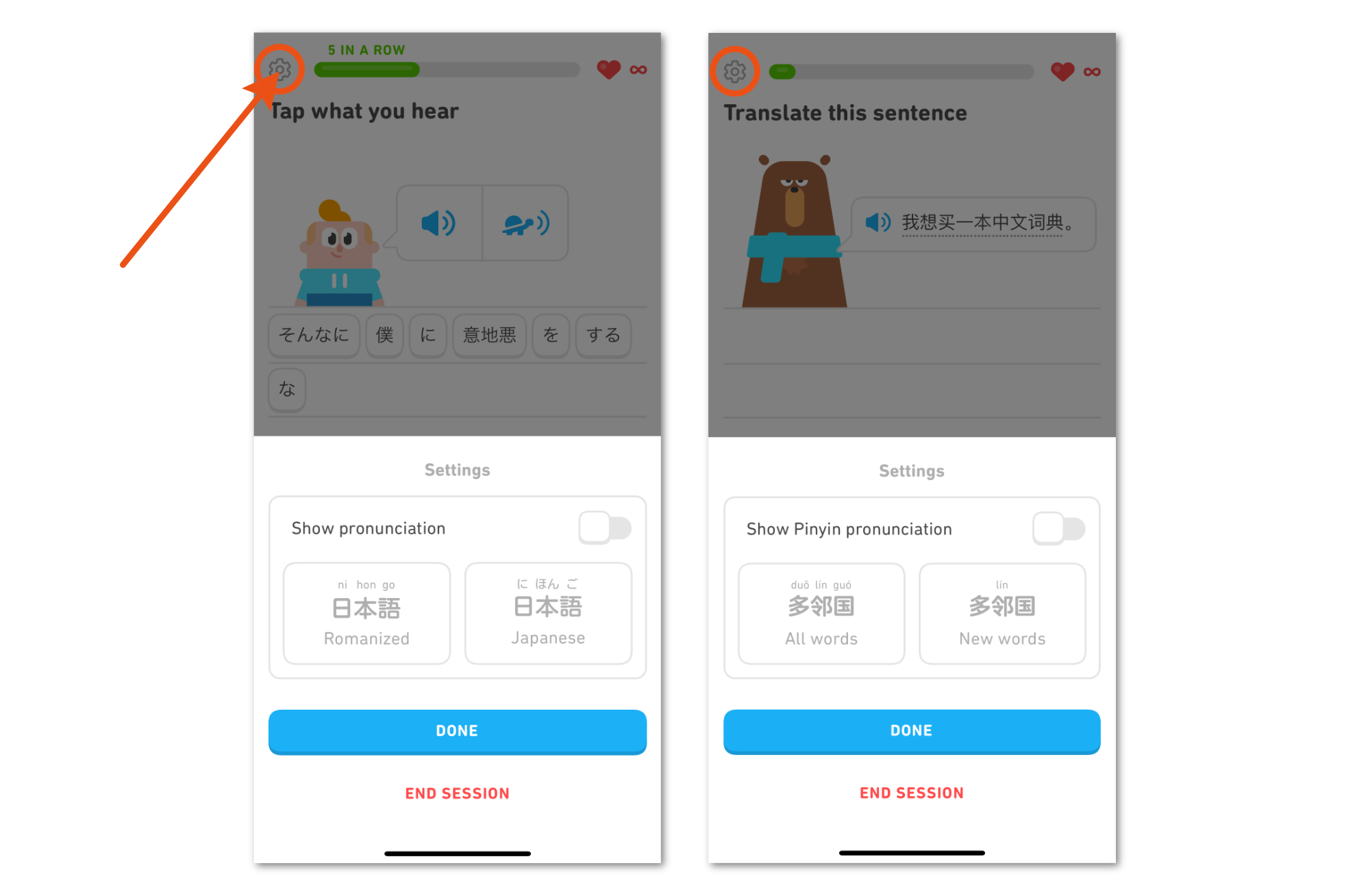
⑦ Customize Reading Guides for Japanese & Chinese
If learning Japanese or Chinese, make sure to adjust the text settings to turn the rōmaji or pinyin reading guides on or off. In a lesson, tap the gear icon in the upper left and then toggle your desired settings.
If you are learning Japanese or Chinese, check out my detailed immersion guides:
Master Japanese: How to Learn Japanese Anywhere in the World
Master Mandarin: How to Learn Mandarin Chinese Anywhere in the World
Both guides show you exactly how to create an effective immersion environment right at home.
About the Author
Hi, I’m John Fotheringham, a linguist, teacher, author, and the creator of the Anywhere Immersion Method™ (or A.I.M. for short).
Whether you are dipping your toes into the linguistics waters for the first time or are ready to dive into the deep end of full language immersion, I will give you the tips and tools you need to succeed (and not feel like you’re drowning along the way).
My blog, books, courses, and newsletter provide the expert guidance you need to learn any language, anywhere, anytime through the power of immersion.
Happy diving!
🤿 Get my best immersion tips + tools 🐠
Join my free Fluency Friday newsletter to get the tips and tools you need to get fluent anywhere in the world.
Download my Free
Immersion Guide
My free Quickstart Immersion Guide shows you how to immerse yourself in any language, anywhere, anytime. You'll learn:
Which essential tools to use.
How to boost comprehension.
How to get fluent right at home.
How to master your mindset.