- Aug 10, 2020
Anthony Metivier on How To Remember New Words, Chinese Characters, Tones & More
- John Fotheringham
- Chinese, Vocabulary, Podcast
Anthony Metivier is the founder of the Magnetic Memory Method, the host of the Magnetic Memory Method Podcast, and the creator of the Magnetic Memory Masterclass. He has refined his memory techniques by learning a number of languages, including Biblical Hebrew, German, Mandarin Chinese, and Sanskrit, and has gone on to teach thousands of learners how to maximize their memories and create unforgettable associations.
I like that his approach combines proven ancient principles with modern brain research, while focusing on practical application like remembering foreign language vocabulary instead of impressive but ultimately useless memory feats like memorizing decks of cards or long strings of numbers.
Anthony is a truly fascinating man with a wide range of interests and insights, and I think you will get a lot out of our conversation.
Topics Discussed
How stress and depression first pulled Anthony into the wild world of memory and mnemonics.
How Anthony applied memory techniques and mnemonics to learn Biblical Hebrew and German.
How memory palaces transform 3D space into a powerful mnemonic device.
Why memory techniques ultimately reduce cognitive load (despite requiring an upfront investment of extra time and energy).
How Anthony uses vocabulary as the “anchor” for phrases and grammar in his memory palaces.
Similarities between learning music and languages (especially in “dedicated practice” of “bars”).
How memory palaces provide spaced repetition without technological distortion or interference.
The pros and cons of spaced repetition tools, and the key difference between passive recognition and active production.
How to creative strong, rapid memories (i.e. how to build more layers of myelin) through “KAVE COG” associations (Kinesthetic, Auditory, Visual, Emotional, Conceptual, Olfactory, and Gustatory).
How to use mind maps to improve memory, refine thinking, and unlock creativity.
Why difficulty can actually improve memory.
“The way we get ourselves to remember is to work at recall.”
Why such memory techniques have survived the test of time.
The many ways in which memory palaces and mnemonics are “joy inducing.”
Anthony’s responses to the common myths about memory, language learning, etc.
How Anthony uses mnemonics and memory palaces to learn Chinese characters and tones.
The importance of movement and dynamism in one’s mental imagery and mnemonics.
How to best structure your time and increase focus.
Anthony’s daily learning routine and the basic principles he applies to all language learning endeavors.
The pros and cons of digital vs. analog approaches.
The critical role of sleep and nutrition in learning and consolidation.
A live, unrehearsed, step-by-step example of creating a mnemonic story using a memory palace.
Why you should physically draw your memory palace on paper.
How to translate slippery numbers into sticky words and images.
Why we are so good at remembering stories, and how stories are really just about space and movement.
How memory palaces let you relive beautiful moments and overcome painful experiences.
Why you should stick with a teacher or method for at least 90 days before trying another.
Resources Mentioned
Books Mentioned
The Talent Code: Greatness Isn’t Born. It’s Grown. by Daniel Coyle
Moonwalking with Einstein: The Art and Science of Remembering Everything by Joshua Foer
Mind Map Mastery: The Complete Guide to Learning and Using the Most Powerful Thinking Tool in the Universe by Tony Buzan
Fluent in 3 Months: How Anyone at Any Age Can Learn to Speak Any Language from Anywhere in the World by Benny Lewis
Remembering the Kanji 1: A Complete Course on How Not to Forget the Meaning and Writing of Japanese Characters by James Heisig
Remembering Simplified Hanzi & Remembering Traditional Hanzi by James Heisig & Timothy W. Richardson
Master Japanese: How to Learn Japanese Anywhere in the World by John Fotheringham
Master Mandarin: How to Learn Mandarin Chinese Anywhere in the World by John Fotheringham
Concepts Mentioned
Dedicated practice (a.k.a. “deliberate practice”)
Serial-position effect (including the primacy effect & recency effect)
Active recall (a.k.a. the testing effect)
HSK (汉语水平考试, “Chinese Proficiency Test”)
People Mentioned
Tim Dalgleish, clinical psychologist
Nelson Dellis, 4x U.S. Memory Champion
Tony Buzan, author
Benny Lewis, author & polyglot
Mattias Ribbing, Grandmaster of Memory
Other Resources Mentioned
Anastasia Woolmer’s TEDx Talk: Memory fit ― How I learnt to exercise my memory
The 8 Best At-Home Workout Routines: The Ultimate Guide for Training Without a Gym
Mandarin Chinese Words Mentioned
zhǔnbèi (準備 / 准备, “prepare” or “preparation”)
duō (多, “many”)
shǒujī (手機 / 手机, “cell phone”)
Connect with Anthony
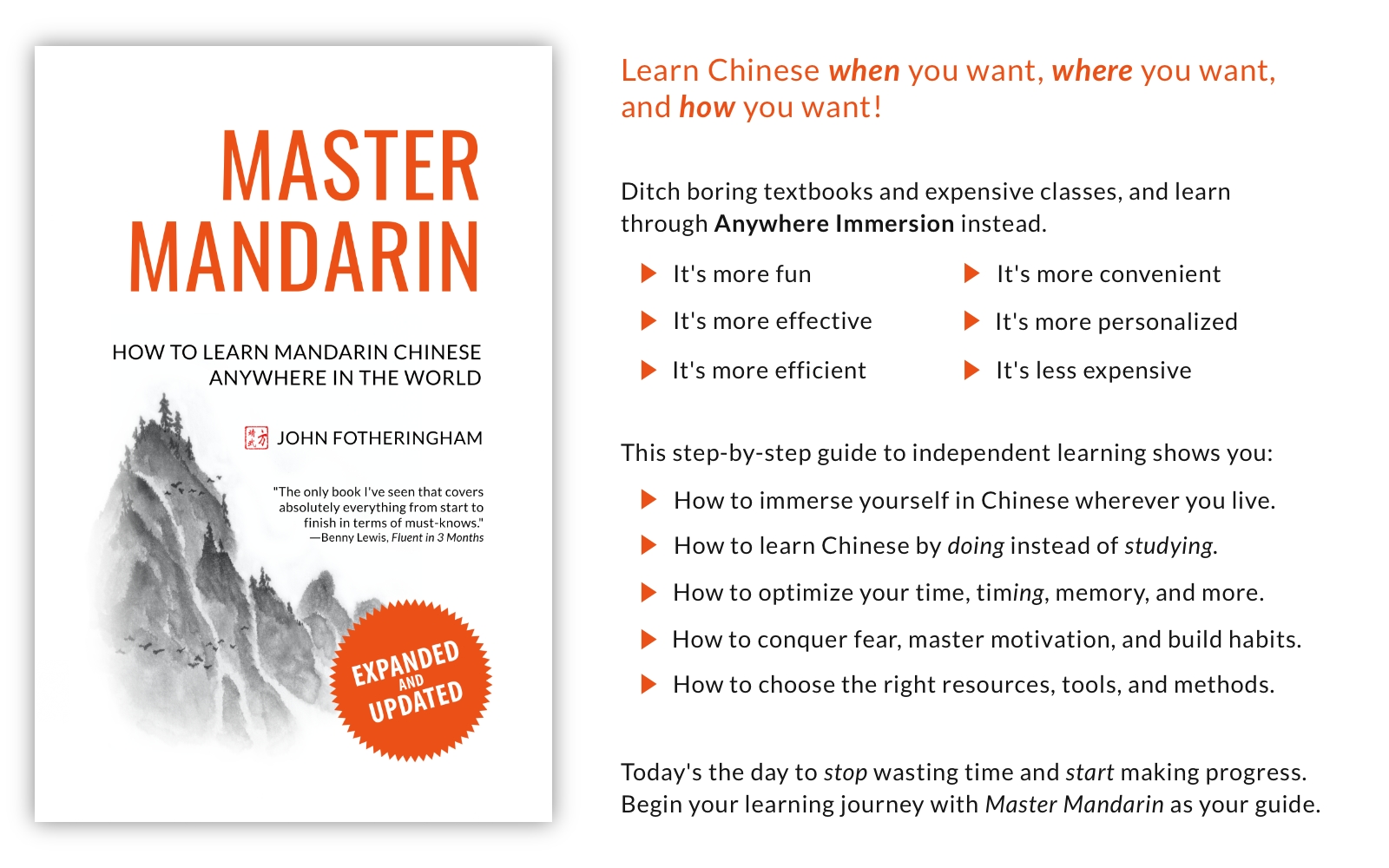
Want more tips and tools to immerse yourself in Mandarin Chinese from the comfort of home? Check out my detailed guide Master Mandarin: How to Learn Mandarin Chinese Anywhere in the World.
About the Author
Hi, I’m John Fotheringham, a linguist, teacher, author, and the creator of the Anywhere Immersion Method™ (or A.I.M. for short).
Whether you are dipping your toes into the linguistics waters for the first time or are ready to dive into the deep end of full language immersion, I will give you the tips and tools you need to succeed (and not feel like you’re drowning along the way).
My blog, books, courses, and newsletter provide the expert guidance you need to learn any language, anywhere, anytime through the power of immersion.
Happy diving!
🤿 Get my best immersion tips + tools 🐠
Join my free Fluency Friday newsletter to get the tips and tools you need to get fluent anywhere in the world.
Download my Free
Immersion Guide
My free Quickstart Immersion Guide shows you how to immerse yourself in any language, anywhere, anytime. You'll learn:
Which essential tools to use.
How to boost comprehension.
How to get fluent right at home.
How to master your mindset.